Showing posts with label blogs. Show all posts

Sunday, November 08, 2009

And He Is Back!!...

Hard to believe that it's been three months since my last post - where has the time gone? It's been a busy Fall in this part of the World, lots going on, but I'm back and ready to post on a more regular basis - here are some of the things I'll be updating and commenting on in the next while:
  • My Virtual Cross Canada Trek - now over 2000 KM in, not sure where that puts me exactly, but I'll update as I hit major milestones and cities
  • Things educational including information literacy, new skills for learning professionals, meta skills for learning professionals, and informal learning...
  • Must "read" audio books (or is that must "listen"?) Hmmm...
  • And anything else that makes me go Hmmm...
Stay tuned...

Saturday, April 04, 2009

Blog or Twitter? Twit or Blogger? Will Ever the Twain Shall Meet? Hmmm...

I've been blogging now for over three years and I really like doing it - it gives me an outlet to say what's on my mind - literally the things that make me go Hmmm... But there is a new sheriff in town and that sheriff is Twitter.

I've been twittering (tweeting? the language is so cool :-)) for well over a year now, but until recently it's mostly been "Home after work", "it's raining out", "off to do laundry" - after all, the primary question that Twitter asks is "What are you doing?". But in the past few months I've noticed a change in how many of my friends (followers, followed?) are using Twitter. They are using it to share information, send links, talk about conferences or meetings they are attending (live in real-time too - very cool) and generally using it for lots more than just a "What are you doing?" tool.

Twitter has become a microblogging tool - a way to blog in 140 characters or less - now for those who know me, and for those who read my posts you know that getting me to say anything coherent in 140 characters or less is a herculean task :-). I'm like Blaise Pascal (or Mark Twain, or T.S. Eliot - someone said it...) - "If I had more time, I would have written a shorter letter". I was never one of those students who EVER had to worry about not hitting the word count on an essay assignment, and talking for 30 minutes is easy - it's the 5 minute speech that takes so much time.

For me that is the conundrum of Twitter and Blogging. It's easy for me to answer the "What are you doing?" question within the 140 character limit, but how do I say anything meaningful? That is a skill that I need to learn and to follow the example of several of my friends and colleagues who do an amazing job of saying meaningful things and sharing great stuff (stuff is the universal technical term) with Twitter.

I really like the real-time "live" nature of Twitter. When I attend conferences I blog the days events - keynotes, sessions I attend, things I did or noticed - it's my way of absorbing the day and reflecting on it (and a great way to share the experience too). With Twitter I can do that as it happens - now that is so cool - I just need to develop some concision (yes it is a word :-)).

The other piece that has made Twitter more relevant to me as an information sharing and discussion tool is the technology I'm now using. I've gone from a simple digital text-based SMS cell phone to an iPhone using an application called Twittelator Pro that gives me an easy way to "tweet" no matter where I am. With these tools I can connect live from anywhere. I'm off to a couple of conferences this Spring (one as a co-presenter - CNIE), and I plan on tweeting from both theoughout the day, and then blogging each evening on the day's events - to me the perfect combination of tools...

So is this the end of blogging as I know it? I don't think so - I will still write scads on things that make me go Hmmm... I will never be able to do that to my satisfaction in 140 characters or less. I still have the need to be wordy and verbose (sorry it's in my nature), but I see Twitter as a valuable addition to my tool set of information gathering and sharing and I can tell you that from now on when I tweet (yes I am a Twit :-)), it will be more than answering "what are you doing"? With Twitter I will be able to find and share information in real-time - then I can use my blog to expand upon (and dare I say pontificate) on those subjects that still make me go Hmmm... in more than 140 characters...

(Images - Twitter logo from Twitter.com and Blogger logo from Blogger.com)

Sunday, January 06, 2008

Personal Living Networks... AHA!!!

One of the best education blogs out there is Will Richardson's Weblogg-ed. It's one of my regular stops in the blogosphere and should be one of yours too.

In a recent post he talks about "Personal Living Networks", and I had an AHA! moment. He quotes Chris Lott:

“In the emerging model, students learn to navigate, assess, construct and participate in a living network that comprises the heart of their learning network and they take that with them when their time as part of any particular institution’s offerings come to a change…’Going to school’ is an activity that has a life and dies; learning is a continuing process. Enrollments and degree programs terminate; personal living networks accompany learners through life– the ultimate educational institution– serving as companion, confidante, and oracle alike.” Chris Lott

Chris Lott is another must read for educators, and he in fact uses the term "personal living environment", feeling that limiting it personal learning environment is too narrow a focus.

Anyone who has read my blog know that I personally believe that PLEs (Personal Learning Environments) are the future of education - they will get us out of our neat rows of desks in classrooms, away from one-way lectures, and allow us to deliver education when, where, how, and why, learners want it. They will place more responsibility on learners to become engaged in their learning, to collaborate with each other and their facilitators, to use mobile devices to get learning when and where they are at and to participate in an open educational environment. In other words what I have coined as ECMO - Engagement, Collaboration, Mobility, and Openness.

What Will Richardson and Chris Lott are saying makes so much sense - it is more than just personal learning - it has to be personal living, that education is a life-long process that they have to manage along with the rest of their life.

I love what Chris Lott says:

"“Going to school” is an activity that has a life and dies; learning is a continuing process. Enrollments and degree programs terminate; personal living networks accompany learners through life– the ultimate educational institution– serving as companion, confidante, and oracle alike."

This is what we as educators have to instill in our learners - if we do nothing else, we must do this...


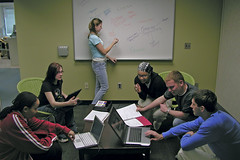
(Photo - "Collaborative Technology Labs"- by MSU Libraries)

Friday, November 09, 2007

The Future Of Media...

ITANS Logo.gifWednesday night I attended the ITANS (Information Technology Industry Alliance Of Nova Scotia) annual dinner. The guest speaker was Ken Rutkowski, media personality, strategist and consultant. The theme of his talk was on the future of media. A couple of cool things came out - one - it's gonna be a busy future, and two - I'm mostly there now!

Ken started his talk by describing old media (TV, newspapers etc.) and new media (Web, RSS, blogs, YouTube etc.) and their products - old media's product is content, while new media's product is the audience - the customer is the advertiser (makes sense - hits is one of the measures of success for an online presence). This distinction may be a little simplistic, but it allows for an identification f new media.

Mobile devices, in particular cell phones (smart devices) is where it is at for the future of media. By 2010 there will 2 billion Nokia cell phones alone in circulation - cell phone penetration is growing and in some nations is well over 90%. I've talked about this in past posts and it's interesting to here an industry expert say the same thing. In my mind it's mobile devices that are the future of education, allowing learners to learn where, when, what, and how they want to.

Ken went on to talk about RSS and push technology, how RSS is pushing information - the customer is the product. I'm a big fan of RSS - push technology is the only way these days to make sense of the sea of information that we are swimming in. Content is everywhere - podcasts, YouTube etc.

Ken then did something very cool- the rest of his presentation consisted of him using Skype to contact "some of his friends", industry experts and personalities who shared their thoughts with us on the future of media. His friends included:

  • Ralph Simon - creator of the ring tone
  • Johnathan Wendel - professional gamer (Fatality)
  • James Sun - CEO of Zoodango - a social networking site that facilitates both online and F2F social networking
  • Scott Page - former member of Pink Floyd and Supertramp, now involved in Web-based technology allowing bands to communicate with their fans

The common thread from each of these incredible people is that it's content and mobility, along with penetration that is going to be the future of social media. Businesses and individuals need to get out there and be active parts of this always on environment - be part of community.

Thanks to ITANS and the organizers for a great evening and a wonderful dinner. I know that the students that we brought along had an amazing time - they saw a glimpse into the future - where they will be working and living, and that is too cool...

Wednesday, November 07, 2007

I Am Blogger - Hear Me Roar!...

Lion.jpgThis whole blogging thing may just be here to stay :-). I've been blogging seriously now for a couple of years and I have friends like Randommind who have been blogging for considerably longer, saying amazing things and sharing their insights and wisdom with the world.

But what is even more amazing are those bloggers who don't always have important or profound things to say - the ones that are simply sharing their lives and momentary thoughts (like this post) with the world. Blogging has become a conversational method and opportunity - I can actually carry on a conversation with people from all over the world through my blog or their blog. Blogs have become, for me, an essential source of information and research - they are probably my primary source of a lot of the information, and inspiration that I get every day - blogs are immediate, relevant and in some instances even intimate as i share thoughts and opinions back and forth with fellow bloggers. Blogs are also a great way to get noticed out there in cyberspace as blogs have built-in search engine optimization (SEO) - you appear in the first couple of pages of results from a search engine. If you want to be visible online - blog!

I get a lot of my daily information from blogs - i literally have hundreds of feeds that I receive daily through Netvibes that I look at - several I read religiously, many I just scan the title for interest, but the point is I am getting my information from a sea of individuals and what they are sharing with the world. Th sheer power of the blog and it's ability to communicate information, opinion, passion, and knowledge is very powerful.

Even institutions and organizations are blogging - at my college, a new blog has just been started to discusses educational technologies - what a cool way for people to get out of their silos and share what they know with others. Together we all get better at what we do. I attended the Atlantic Internet Marketing conference last spring and one of the tips given there was for all companies to have a blog - be part of the process, talk to your customers and clients - build that personal relationship with them through blogs and just as importantly, get to the top of the search engine heap with SEO.

Many of my friends are blogging and you can see some of their links on my blogroll and my Feevy feed off to the right side of my blog - it's this ability to network and feed off of each other,to engage in conversations that makes blogging such a cool experience for me - it's not that I actually have anything profound or important to say, it's that I have SOMETHING to say and so do the millions of others out there who blog, and occasionally someone listens and comments back the conversation... It's very cool to hear what they have to say. We are bloggers - hear US ROAR!!...


(Photo - Lion by tgraham)

Saturday, November 03, 2007

When Does a Blog Become a Web Site?...

When does a blog become a Web site? I've been asking myself that question the last little while as I take a look at my blog and at the blogs of friends and those that I read on a regular basis. When I started writing my blog it was just that - a place to write down some thoughts - sort of a blank journal. It had a couple of extras - my profile, a picture of me and the Blog archive - neat, clean, no fuss, no muss.

Now look at my blog - at last count there were 19 different things, widgets, components, add-ons, whatever you want to call them - from links to blogs I read, my wiki, my Flickr site, my Facebook profile, blog aggregator sites like Technorati, Feedburner, Netvibes, PageFlakes, and EduSpaces. I can chat through Meebo and stay in touch with Twitter. I can tell how many people are reading my blog through ClustrMaps (come on people where are you?), and I even have pictures of my favourite bloggers on my blog through Feevy.

When did my blog get so crowded anyway? It all just sort of snuck up on me. The other thing is now whenever I set up a profile in Facebook, Orkut, LinkedIn or any other social media site, I always put my blog as my web site. I own a domain but haven't done anything with it (I really should) because I'm not a really big fan of "vanity" Web sites. But if you take a look at my blog - vanity thy name is...Me! Hmmm...

Friday, June 15, 2007

STLHE 2007 - Conference Day One - Educational Blogging - Applications and Challenges

This session was conducted by Zuochen Zhang from the University of Windsor. His presentation was mostly about the use of blogs by younger learners (K-12), but had some application for post-secondary use.

There was lack of understanding in the audience of what blogs are. Zhang recommended that blogs could be used for assignments to get you out beyond the box of traditional assignments.

He also recommended to not overdo blogs - don't get students to blog if everyone is getting them to blog - coordinate the process.

This short 30 minute presentation confirmed that what I am doing with blogs and what I plan on doing with blogs is on track...

Tuesday, May 15, 2007

Atlantic Internet Marketing Conference (AIM 2007) Day Two

Another information rich day at AIM 2007. Today's focus was more on the technologies and tools available for companies and marketers to do what it is they do attract and retain customers.

Here are the highlights of the presentations that I attended, followed by my thoughts on the day and the conference.

Secrets of Successful Web Sites

The presenter was Rob Swick, Senior Strategist, AlphaSearch (and one of the driving forces behind AIM 2007).

"The main thing is to make the main thing the main thing" - Mike Lipkin. In other words - focus on what it is you do and do it well. here are the main things for a successful Web site:
  1. Planning - Create a plan
  2. Create (borrow, steal) rules
  3. Strive for structure and simplicity
  4. Home page is the main page
  5. Understand the team, what they do
  6. Fill the Funnel - grow the relationship - be found
Some of Rob's rules:
  1. Navigation buttons - 7 or less
  2. Tools go in the "tool nav"
  3. People don't read, they skim
  4. Earlier pages promote internal pages
  5. Show it
  6. White is your friend - whitespace and white backgrounds are OK
  7. If you are not capturing e-mail addresses you are wasting money
Panel Discussion - Understanding Internet Technology
  • Managing client expectations is the most important thing - know exactly what a Web page will and won't do
  • Keep things fresh and updated
  • Simplify technology for clients
  • Understand costs involved in site design/video production
  • Communication is essential
  • Bridge the gap between client wants and reality
  • Panel was somewhat anti-geek/anti-technology, more focussed on business processes
Electronic Personality and Positioning

Presenter was Wilma Hartmann from Applecore Interactive

Web sites that work have their own personality - it's all about identity alignment


The total online experience is carried on the following four pillars:
  1. Design
  2. Content
  3. Navigation
  4. Functionality
There are things you can control about your Web site and things you cannot control or can only influence:
  • You can control
    • Domain URL
    • Search Engine
    • Links
    • Partners/affiliates/listings
    • Online advertising
    • e-News/e-Mail
    • Traditional Marketing and advertising
Web 2.0 is like nailing jello to a wall - you have little control
  • You cannot control
    • Blogosphere
    • RSS
    • Podcasts
    • Social marketing/chat
    • Rooms/newsgroups
    • Unsolicited listings
  • You can influence
    • Bologosphere
    • RSS
    • Podcasts
    • Social marketing
    • Unsolicited listings
Emerging Web 2.0 values:
  • Authenticity
  • Democracy
  • Innovation
  • Co-creation
How do you protect your brand in this fluid environment (thriving in a co-creative world)?
  • Monitor (Google/Yahoo, yourself)
  • Influence (be a part of Web 2.0)
  • Stay true to who you are
Future decisions for emerging media - do we or don't we. For example Sweden has set up an embassy in Second Life. Adopt what works with your personality

Digital Content and marketing in the Multi-Platform World

Presenter was Graham MacDougall, Director of Digital Media, DHX Media

A changing media landscape - much more complex and fractured environment- digital media formats/devices/tools

Major changes in how people access media

Content/Distribution Models
  • Blogging - personify brands
  • Podcasting -fivefold increase in revenue from 2006-2011)
  • Social networking - 1 out of 4 Internet users access a social networking site once per month
  • Rich media - Flash, video
  • Music - now 10% of total music sales
  • IPTV (Internet Protocol TV - Joost, Apple TV, JumpTV)
  • Mobile - 20% of users browse Web from cell and smart phones, but slow growth for now
Graham highly recommended Jakob Nielsen's book The Web Bible - Prioritizing Web Usability

Viral Marketing

Presenter was Sarah Oldford, Online Media Manager, Colour

"You don't find your audience - your audience finds you"

There are now many ways to reach out online. Viral marketing is the phenomenon that facilitates and encourages people to pass on a marketing message
  • No defined viral campaign strategy
  • No solid best practices - it's constantly evolving
  • There is however, trying too hard
  • Avoid copying/mimicking existing viral campaigns
  • Viral marketing is hit or miss
  • Start with the brand
  • Look to your marketing messages for brainstorming
  • When you have a relevant, fun idea then talk about online
Who has done it well?
Panel - Which Medium For My Message?
  • Understand your audience
  • Think like your customer/consumer
  • Capability of organization to support channel selected
Mediums
  • RSS - push content
  • Blogs - highly search engine friendly
  • Tagging - Digg, del.icio.us, technorati
  • Rich media
  • Text
  • Cell phones / smart devices
These must all be used appropriately - need to use more than just one technology and possibly multiple formats of the same content (Real, Quicktime etc.)

Blogs are trust mechanisms

Panel - The Good, he Bad, and the Ugly

The final session of the day, the panel reviewed several Web sites of attendee companies and others. They were mostly unkind, finding fault with most, which was interesting, because several of the reviewed sites were created by panel members (which just goes to show you that if you put four Web developers in a room, you will get at least six opinions).

My Thoughts

It was another information packed days. It is apparent that the marketing world is aware of Web 2.0 and is doing its best to take advantage of these tools and technologies. There is still a gap between the knowledge of the marketing professionals and business owners. many are still trying to come to terms with the potential impact and benefits of Web 2.0 and social networking on their businesses.

It will be interesting to see where marketers go next. With the media markets now so fractured, marketers must decide which channels to use to get their messages out. It looks like the Internet is rapidly becoming the channel of choice, and that all types of devices and approaches to making customers aware of what is available will be the next frontier...


Thursday, May 10, 2007

Randommind - A Must Read - The Sequel

I have already told you that Randommind is a must read blog (my friend Carolyn is amazing - so insightful and always on topic), but there are two recent posts on the blog that really are must reads.

The first one is PLE ON A Cellphone?. What an incredible idea and what an AHA! moment for me. Talk about breaking down the walls of education. I am a big believer that PLEs are going to have a major impact on my learners and myself in the next few years. What an amazing concept - create a learning environment that works for you, the learner. To take it the next step and make it mobile - too cool. Just think of the learning opportunities... Check out the post.

The second post is Facebook Banned By Ontario Government. The Ontario government has banned provincial employees from using Facebook, which I find just mind-boggling. I'm currently using Facebook as a way to stay in touch with past, current, and even some future learners (not to mention colleagues, friends, and even some complete strangers) - it's a very powerful tool for getting information out. I've had learners get work from jobs and opportunities posted by other learners - too cool! I am seriously looking at Facebook as a learning tool (a future post).

If one of the jobs of a provincial government is to stay in touch with the residents of the province what better way to do it than Facebook. Like Randommind says in her post, even the Premier of Nova Scotia has a Facebook site. The reaction of the Ontario government to Facebook reminds me of the way a lot of organizations reacted years ago to the use of the Internet during working hours placing restrictions on its use. Well those restrictions are mainly gone now, and I suspect the same will happen with Facebook - it is just too valuable and useful a communication tool.

Thanks for the always great stuff Carolyn. I can't wait for your next post...

Sunday, April 01, 2007

Blog Power Redux - Some of My Favourites

If you look at my blog archive, you can see that this whole blogging thing has really started to gain momentum with me. Not only am I writing posts, I am using other people's blogs more and more as information sources. There are many blogs that I now read on a regular basis and I thought that I would share some of them with you. So here, in no particular order (actually grabbed from my Netvibes tabs) are some of my favourite blogs and their authors (bloggers?). Check them out for yourself:
As you can see a long and varied list focussed primarily on technology, education, Web 2.0, and Second Life. Check these out and if you have a favourite blog or two (or ten) let me know about them. Share the wealth...

(Photo from Kosmar)

Thursday, March 29, 2007

Blog Power and Other Things

It's been a good day for Blog Power...

One of my fellow faculty members has just been selected to attend Microsoft's Tech Ed 2007 conference June 4-8 in Orlando. While attending a conference is not that unusual, the manner in which he has chosen to report on the conference is. He plans to blog and use wikis to keep us all up to date on his preparation, attendance, participation, and after action. This is not new in the world of the blogosphere, but is pretty new to us - very cool. I think it will have a major impact on things here at NSCC.

Robert Talbert is an associate professor of mathematics and computing science at a small liberal arts college in the Midwest who writes the Casting Out Nines blog. He has a recent post "Escaping Textbooks" that is near and dear to my heart. He is in the process of developing a textbook-free course in Modern Algebra and already has a textbook-free problem-solving course which intrigues me as I also teach a Logic and Problem-Solving course. More importantly he will be blogging his course development process. I'm really looking forward to following along.

One of my students read my earlier post about not using textbooks "My Next Textbook - Google Notebook", and has decided to create a Google Notebook of common Visual Basic syntax and structures that he will share with his fellow classmates. Very cool.

I'm now exploring the use of Google Groups as a collaborative learning space/resource repository and will be running all of my courses this Fall using blogs, wikis, and other Web 2.0 tools to support learning and foster engagement. I have been greatly encouraged to do this by the generosity of other travellers in the blogosphere as they share their educational experiences through their own posts.

All in all, a VERY good day for Blog Power...

Saturday, February 24, 2007

Tag! You're It...

As I continue to look at all of the new tools and technologies that are cropping up all over the Web, I 'm trying to figure out what exactly makes a Web 2.0 application a Web 2.0 application. Is it user customization, social networking, sharing and modifying information, or something else?

The one common thing that I have seen in most of the Web 2.0 applications that I have looked as is tags - the ability to categorize or group what you are doing so as to make the information produced easier to share and find.

So, is it valid then to say that in order to be a Web 2.0 application, tags must be used? While not all inclusive, I think it's a valid "litmus test", and a way to identify something as being Web 2.0. Here are just a few Web applications that use tags. You can decide if they are Web 2.0 or not:
And I know that there are many, many more... Which ones are your favourites?