Showing posts with label social networking. Show all posts

Friday, January 30, 2009

Getting To Know You... Are Online Friends Real?

I know several people that I consider friends that I have never met face to face (F2F). Some I have know for several years - we correspond through text, e-mails, or hang out represented by our avatars in places like Second Life. Are these people any less my friends than those I see regularly F2F in the "real world"? The only differences are that in many cases I probably say more and open up more to my online friends than my F2F friends, and I can't visually see my online friends.

Can you have friends that you have never actually met in the physical world? I think you can.

I've been doing a lot of thinking on this one - can you get to know someone better online than you can in a F2F (face to face) environment? Just think of the people who met online and ended up together in the "real world". Many of the couples like that I know say that one of the advantages was they "knew" each other before they met F2F.

Here is my premise:
  • It's easier to get to know someone on line because a lot of the social strictures are gone - it's not bosses and employees or peers it's just a group of people doing the same thing
  • It's sort of like the opposite of Cheers - "where NO ONE (instead of every one) knows your name...". People who would be too shy to say something F2F are comfortable to share online - they are not hampered by appearance, or position, or place...
Do you think this is true or is it just my fevered imagination? I've become so comfortable online that I no longer really differentiate between the two - I have friends - it's just that some of them I have only met in text. Hmmm...

Sunday, January 04, 2009

Facebook Is The Malt Shop Of The 21st Century Or Where Do You Hang Out?...

This post is one from my To-Do list. Thought it was about time I got around to this - some thoughts on how we as a species, at least in the connected world, have changed how we meet people, make friends, and hang out...

When I was growing up we hung out at drive-ins, bowling alleys, hockey rinks, community centres, sports fields, and other real spaces. The people we met and the friends we made were local and we met face to face. I moved around a lot as an army brat and over the years lost track of old friends, making new friends at our new posting. Some you kept in touch with by letters, but I was (and am) a lousy letter writer. Our friends were "real" we knew their names and we knew what they looked like.

Welcome to 2009 and Web 2.0, virtual worlds, micro-blogging sites like Twitter, and social networking sites like Facebook, LinkedIn and Orkut (among literally hundreds), not to mention online dating sites like e-Harmony. The whole meeting, making, and keeping friends paradigm has changed. You can now meet people from all over the world, get to know them and create lasting friendships and relationships without ever meeting. Staying "in touch" is easy and is now pushed to your friends by simply updating your status. You can develop a deep or lasting relationship that once it becomes face to face (or "real" as some would say) continues to be stroong.

The question is can you be friends with someone you have never met? My answer to that question is yes. I know several people that I consider friends who I have never met face to face, yet our relationships are normal and friendly. I've met most of these people through Second Life, and some through Facebook. Some I have met face to face in the "real world", some I will probably never meet yet I still consider them friends and no less a friend simply because we have never met face to face. What sites like Facebook and Second Life have done is simply expanded my "First Life" - my social circles and networks are now global, not loacal...

Anna Pickard in the Guardian posted an article called "Virtual people, real friends" (thanks to Randommind for finding this). It's a great read and makes the point that you can have real friends with virtual people. In the article Anna says:

"The friends I've made online – from blogging in particular, be they other bloggers or commenters on this or my own site – are the best friends I now have. And yet, when I say this to people, many times they'll look at me like I'm a social failure; and when surveys like this are reported, it's always with a slight air of being the "It's a crazy, crazy, crazy world!" item last thing on the news. Some portions of my family still refer to my partner of six years as my "Internet Boyfriend".

Call me naive, but far from being the bottomless repository of oddballs and potential serial killers, the internet is full of lively minded, like-minded engaging people – for the first time in history we're lucky enough to choose friends not by location or luck, but pinpoint perfect friends by rounding up people with amazingly similar interests, matching politics, senses of humour, passionate feelings about the most infinitesimally tiny hobby communities. The friends I have now might be spread wide, geographically, but I'm closer to them than anyone I went to school with, by about a million miles.

For me, and people like me who might be a little shy or socially awkward – and there are plenty of us about – moving conversations and friendships from the net to a coffee shop table or the bar stool is a much more organic, normal process than people who spend less time online might expect.

Depending on the root of the friendship, on where the conversation started, the benefit is clear – you cut out the tedium of small talk. What could be better?"

This is the new reality of where people are "hanging out" and meeting - many social places of my youth are gone or are no longer safe to hang out at - we have switched to an online world of common interests, acquaintances, linked friends (the real six degrees of separation), and online communities where we meet and make friends.

This new reality has implications for educators too - our learners are hanging out in these new online spaces, making friends, collaborating, defining relationships and creating networks. We need to understand how this works, understand that friends made in this new paradigm are just as real and just as important as any "real-world" friends and that these virtual friends will impact on learning environments and how we will relate to our learners.

As we move to more and more blended or online deliveries, many of our learners will only be known to us through their online presence. Does that make them any less a learner or are the friendships and relationships they develop with their classmates and us any less relevant or important? Hmmm...


(Photo - "Blast From The Past" by Steve_Tango)

Sunday, December 28, 2008

How Many Web 2.0 Tools Are Too Many?...

I've been hooked on all things Web 2.0 since even before Tim O'Reilly coined the phrase. Just within my bookmarks on my browser (Firefox, the perfect Web 2.0 browser), I have 85 Web 2.0 tools and applications bookmarked, along with literally hundreds more in my Delicious tags. Those 85 are bookmarked in my browser because I have actually registered with those sites (a common Web 2.0 ploy) in order to try them out and actually used them, at least once. They go from Aviary to Zui Prezi, a compendium of tools and apps that have changed the way I compute. I'm not even counting apps like iTunes and sites like audible.com which have bcome huge parts of my life (and that I consider part of the Web 2.0 space)

You can argue exactly what constitutes a Web 2.0 tool, but in my mind it is anything that pushes information to me or allows me to collaboratively work and share on the Web while using a Web-based interface - the browser as operating system...

My question is how many Web 2.0 tools are too many? Obviously the 85 that I have tried is way too many - besides many of those tools are long gone (have you noticed that another feature of Web 2.0 tools is that the word "Beta" must appear on their Web site somewhere?), Pownce being one of the latest casualties, or been absorbed or morphed by competition. Having tried them as they appear does not mean that they are being used or even useful. Here is a list of the Web 2.0 tools that I use regularly, in no particular order:
  1. Blogspot - blogging
  2. PBWiki - wiki
  3. GMail - mail, chat, video chat, and so much more...
  4. NetVibes - RSS etc. aggregator
  5. Google Docs - office application suite, collaborative groupware and so much more
  6. Flickr - photos
  7. Photobucket - photos
  8. Twitter - micro-blogging and social networking
  9. Delicious - tagging
  10. Facebook - social networking
  11. LinkedIn - social networking
  12. Joost - online video and TV
And I know there are others that I visit on a less regular basis. Not bad - 12 down from 85 - but even with 12, it's become a full time job just keeping up trying to remain a cool Web 2.0 dude. The thing is, do I really need 12 Web 2.0 tools to do what I do on the Web (and what I do is more and more all on the Web, I think my desktop has cobwebs on it...)? I look at that list and it seems all I have done is transferred how I work with desktop apps to Web 2.0 apps - do I need to develop new skills and ways of integrating what I do, or am I looking for that one killer Web 2.0 (or Web 3.0, or Web 4.0...) app that will do it all (and I am becoming more and more convinced that the whole Google Apps/GMail/Google Labs mashup may just become that killer app)? Hmmm...

What Web 2.0 apps are you using and how are you using them? Have they changed the way you get and use information?...

Monday, December 31, 2007

Looking Back, Looking Forward...

Happy New Year everyone! Hard to believe that another year is past and a new one about to begin. Thought I would take some time to look back at 2007 and look forward to 2008 (everyone is doing it - so figured I might as well too!).

I posted over 150 times in 2007 - my God I'm wordy! Hopefully I had some things to say that actually made sense. Many of my posts happened at conferences I attended (STLHE 2007 and CIT 2007) - I found that blogging the conference experience "live" was a great way to fully experience what was happening - great way to reflect on the day's events and get ready for the next day.

I also spent a lot of time focussing on education and in particular what I see as the future of education - the Personal Learning Environment (PLE). PLEs, and the increased use of mobile devices will have a major impact on how we design and deliver learning over the next few years. Learners will want more specific and customized learning that will fit into their increasingly busy lives - more flexibility, more options. Institutions will leverage distance and blended learning to increase enrollments with limited investments in capital building projects (and online courses cost a lot less than having to build additional brick learning spaces).

So here is what I think will be the "big things" of 2008:
  1. Blended learning and blended learning opportunities will increase - in the end (maybe not the end of 2008 but soon after), more learners will be taking a blended approach to learning than a traditional classroom only model
  2. Second Life will continue to grow and will be bought by one of the big players in the Internet (Google, Yahoo, Microsoft...)
  3. Open Source will continue to take away from proprietary software - Google Docs and similar online collaborative "suites" will increase in use and popularity
  4. Web 2.0 apps will become mainstream as businesses and educational institutions start to use them regularly
  5. E-Mails use will decline in favour of IM, Twitter, Facebook and other more immediate forms of communication - EMail will be for "communicating with old folks"
  6. Facebook will still be big, but may decline as people become tired of all of the "applications" cluttering up the interface. Look to Orkut and other social networking sites to grow among those wanting to be social without all of the "other stuff". Ning will grow in the creation and use of personal and customized social networking sites
  7. I hope that someone creates the social networking equivalent of Meebo allowing me to use one interface for all of the social networking sites that I belong to - Facebook, LinkedIn, Bebo, Ning...
  8. Microsoft Windows Vista will continue to struggle, good news for Apple and Linux distros like Ubuntu. More and more educational institutions will look at multi-boot Apple computers as the solution to their IT infrastructure needs.
  9. The iPhone will come to Canada - PLEASE!!!! The iPhone is the future of learning...
  10. I'll continue to blog in 2008, focussing on education and other things that make me go hmmm... including my new mantra of ECMO - Engagement, Collaboration, Mobility, and Openness - it's where education has to go...
To provide some balance, here are some other views of the year past and the year to come:
So there you have it - a quick look back and a quick look forward. All I can say is that I'll continue to post here and hopefully some of it will even make sense.

Happy New Year everyone!


Gotta love iStockphoto - this same image is on the front page of today's Ottawa Citizen!

(Photo - Janus Coin by Marco Prins)

Thursday, December 20, 2007

Convergence Culture and Education...

I've just finished reading Henry Jenkins's book "Convergence Culture", and let me just say that if you have not yet read it that you should. His blog "Confessions of an Aca-Fan" should also be required reading for anyone interested in modern media, culture and their impact on what we do day to day. Essential reading for educators.

The book is full of useful information and insights, and I had several "AHA!" moments while reading it. The central theme of the book is that we are in a new media era where it is the consumer that is dictating the content, style and presentation of media and its content, not the traditional "old media" of large companies and defined media steams (radio, TV, newspapers, etc.) dictating when, where, what, and how we receive our content. Henry Jenkins presents a clear picture of the way our learners look at media as a tool that they can and should control, with them dictating the when, where, what, and how of content. Here are some of the highlights of the book for me (all attribution for excerpts from the book to Henry Jenkins):
  1. The distinction between mass culture and popular culture - mass culture is a category of production while popular culture is a category of consumption. Popular culture happens when the materials of mass culture get into the hands of consumers - Henry's example is a song becoming an "our song" for example. I like this definition and in my mind there is a definite shift towards popular culture as consumers take things on board for themselves and have much more creative freedom because of the Web and the tools now available to create and consume culture.
  2. How the smart media companies seized on convergence culture and became successful because of it and the best example is probably the "Star Wars" juggernaut. Part of the massive appeal of Star Wars and the mythology that has grown up around it has to do with how George Lucas has allowed consumers to craft their own visions of the legend and to expand upon the legend through the creation of their own movies and stories. the book also cites examples of old media organizations who didn't quite get it right by zealously "protecting" their brand and copyrights (we know who you are, don't we?)
  3. How convergence culture, and in particular blogging had an impact on the 2004 US presidential campaign. Blogging changed the dynamic of traditional news and public opinion (anyone could now be a political commentator), and changes to campaign funding rules shifted control of the campaigns from the candidates to independent action groups (remember "Swift Boat Veterans for Truth"?). The political scene in the US (and I suspect everywhere in the developed world at least) has been forever changed by the shift to consumer engagement in the use of the media.
  4. The biggest "AHA" moment for me was when Henry Jenkins stated that one of his book's central arguments is that the biggest change occurring with media is the shift from individualized and personalized media consumption towards consumption as a networked practice. Boy is this so true! Just listen to a group of learners discussing what they have watched or read, or how the are telling each other about what they found on the Web last night - it's one of the most powerful learning tools we have today - collaborative learning.
  5. One of the final thoughts n the book is about education - historically public education in the US (and the same can be said for the education system in Canada) was meant to distribute the skills and knowledge necessary to train informed citizens. This doesn't work anymore - we have a participation gap and citizens today need to be more than informed, they need to be monitorial - not just being able to read and write but being able to participate in the deliberation over what issues matter, what knowledge counts, and what ways of knowing command authority and respect. The ideal of the informed citizen is in trouble because there is simply too much to know. The ideal of monitorial citizenship depends on developing new collaboration skills and a new ethic of knowledge sharing that will allow people to deliberate together. (page 259). This describes for me exactly the issues I am seeing in the classroom with learners - they need these "new literacy" skills of collaboration and information sharing in order to manage the sheer volume of information available today.
  6. The problem is that people for the most part are learning these new skills outside of any formal educational institution - they are developing their skills through affinity sites, newsgroups, social networking sites and other new media opportunities - Henry Jenkins actually points out that many schools are openly hostile to these developing skills and go out of their way to stop their development (anyone blocked Facebook recently?). This HAS to stop - it does a disservice to learners - we need to foster and develop these collaborative skills - they are essential to the future of our learners and our educational process.
As you can see Convergence Culture has had an effect on me that I think will improve what I do as an educator - I cannot recommend too highly it or anything else that Henry Jenkins does - if you have an opportunity to read what he writes or listen to what he says, take it...

Saturday, November 17, 2007

CIT 2007 - Opening General Session - Dr. Mark Milliron


Dr. Mark Milliron, president and CEO of Catalyze Learning International, was the opening general session keynote speaker. As such he is recognized as a leader in educational leadership and the use of technology in education. An extremely engaging speaker he talked about the changing face of learners and how technology and tools like social networking are going to change the face of community college education.

Community Colleges are preparing for multiple generations of learners and have to be prepared for all of them:

Baby Boomers (the family generation)
Gen X (the ME generation)
Net Gen (the WE generation, or as I have heard it coined, the "XBox generation")

Along with this we have to realize that there is an ongoing digital divide - broadband vs. dialup and that there are still dialup ghettos that will impact how and what technology can be delivered to learners.

Dr. Milliron talked about what is in store:
  • Attract, Service, Retain and engage learners
  • Visioning
  • Planning
  • Fund raising
    • Capital
    • Operational funds
    • Maintenance funds
  • Sustainable Learning Environments
We are going to see the following things influence how we will provide learning opportunities to our learners:
  • Blurring and Blending
  • Mobility Galore
  • Gaming
  • Social Networking
  • High Impact Presentations/Engagement
  • Analytics, Diagnostics, Evidence-based education
  • The Human Touch
For blurring an blending we will see models of 20% of learners online, 20% face to face and the remainder taking a blended approach to their education. I know that this is something that I ned to take very seriously as an educator when looking at maintaining and developing curriculum and programmes.

Mobility galore - m-learning will be big - learners need access - the oasis effect - free wireless will keep learners engaged and on campus

Gaming - a whole different way to learn. Look at seriousgames.org and americasarmy.com for examples.

Social Networking is engaging and connecting - collaboration is key. Second Life - a bridge between gaming and education. Of the social networking sites Dr. Milliron compared MySpace as Bart and Facebook as Lisa (or Potsie and Ritchie depending on your generational analogies...). The OER Commons is social networking for faculty.

Take your work seriously and yourself lightly when dealing with net geners (makes sense and it works in my experience). Sixteen to twenty-year olds want IM or chat - not email or readings "EMails are whta old folks send me" - so true - just try getting learners to read their e-mails - Facebook a much faster way to communicate with them.

We need to build buildings with high impact presentation technologies and tools in them - retrofitting no longer working.

The use of analytics to determine the best use of resources is a critical process that we need to start using, just as the gaming industry has been doing for years.

On the Human Touch we need to have the courage to be open to opportunities, the courage to catalyze the conversation, and the courage to learn.

We need to engage all learners in this process, including the CAVE people - Colleagues Against Virtually Everything (and you know who you are..).

A great keynote to kick off CIT 2007 - what we need to do as we look forward and the good news for me is that I get it it. Can't wait to see what the rest of CIT 2007 brings...

Friday, November 09, 2007

The Future Of Media...

ITANS Logo.gifWednesday night I attended the ITANS (Information Technology Industry Alliance Of Nova Scotia) annual dinner. The guest speaker was Ken Rutkowski, media personality, strategist and consultant. The theme of his talk was on the future of media. A couple of cool things came out - one - it's gonna be a busy future, and two - I'm mostly there now!

Ken started his talk by describing old media (TV, newspapers etc.) and new media (Web, RSS, blogs, YouTube etc.) and their products - old media's product is content, while new media's product is the audience - the customer is the advertiser (makes sense - hits is one of the measures of success for an online presence). This distinction may be a little simplistic, but it allows for an identification f new media.

Mobile devices, in particular cell phones (smart devices) is where it is at for the future of media. By 2010 there will 2 billion Nokia cell phones alone in circulation - cell phone penetration is growing and in some nations is well over 90%. I've talked about this in past posts and it's interesting to here an industry expert say the same thing. In my mind it's mobile devices that are the future of education, allowing learners to learn where, when, what, and how they want to.

Ken went on to talk about RSS and push technology, how RSS is pushing information - the customer is the product. I'm a big fan of RSS - push technology is the only way these days to make sense of the sea of information that we are swimming in. Content is everywhere - podcasts, YouTube etc.

Ken then did something very cool- the rest of his presentation consisted of him using Skype to contact "some of his friends", industry experts and personalities who shared their thoughts with us on the future of media. His friends included:

  • Ralph Simon - creator of the ring tone
  • Johnathan Wendel - professional gamer (Fatality)
  • James Sun - CEO of Zoodango - a social networking site that facilitates both online and F2F social networking
  • Scott Page - former member of Pink Floyd and Supertramp, now involved in Web-based technology allowing bands to communicate with their fans

The common thread from each of these incredible people is that it's content and mobility, along with penetration that is going to be the future of social media. Businesses and individuals need to get out there and be active parts of this always on environment - be part of community.

Thanks to ITANS and the organizers for a great evening and a wonderful dinner. I know that the students that we brought along had an amazing time - they saw a glimpse into the future - where they will be working and living, and that is too cool...

Wednesday, November 07, 2007

I Am Blogger - Hear Me Roar!...

Lion.jpgThis whole blogging thing may just be here to stay :-). I've been blogging seriously now for a couple of years and I have friends like Randommind who have been blogging for considerably longer, saying amazing things and sharing their insights and wisdom with the world.

But what is even more amazing are those bloggers who don't always have important or profound things to say - the ones that are simply sharing their lives and momentary thoughts (like this post) with the world. Blogging has become a conversational method and opportunity - I can actually carry on a conversation with people from all over the world through my blog or their blog. Blogs have become, for me, an essential source of information and research - they are probably my primary source of a lot of the information, and inspiration that I get every day - blogs are immediate, relevant and in some instances even intimate as i share thoughts and opinions back and forth with fellow bloggers. Blogs are also a great way to get noticed out there in cyberspace as blogs have built-in search engine optimization (SEO) - you appear in the first couple of pages of results from a search engine. If you want to be visible online - blog!

I get a lot of my daily information from blogs - i literally have hundreds of feeds that I receive daily through Netvibes that I look at - several I read religiously, many I just scan the title for interest, but the point is I am getting my information from a sea of individuals and what they are sharing with the world. Th sheer power of the blog and it's ability to communicate information, opinion, passion, and knowledge is very powerful.

Even institutions and organizations are blogging - at my college, a new blog has just been started to discusses educational technologies - what a cool way for people to get out of their silos and share what they know with others. Together we all get better at what we do. I attended the Atlantic Internet Marketing conference last spring and one of the tips given there was for all companies to have a blog - be part of the process, talk to your customers and clients - build that personal relationship with them through blogs and just as importantly, get to the top of the search engine heap with SEO.

Many of my friends are blogging and you can see some of their links on my blogroll and my Feevy feed off to the right side of my blog - it's this ability to network and feed off of each other,to engage in conversations that makes blogging such a cool experience for me - it's not that I actually have anything profound or important to say, it's that I have SOMETHING to say and so do the millions of others out there who blog, and occasionally someone listens and comments back the conversation... It's very cool to hear what they have to say. We are bloggers - hear US ROAR!!...


(Photo - Lion by tgraham)

Sunday, November 04, 2007

The Death Of The Chemistry Set...

Chemistry Set.jpgAn interesting post at The 12 Angry Men Blog - "Endangered Species - The Chemistry Set". That prized toy of my youth, those vials and bottles, and tubes of elemental mystery is about as safe as the dodo on the road to extinction. Yet one more casualty of the war on terrorism. Or is it?

I remember my chemistry set with some fondness and I am sure that like most pre-teen boys who had one, the most fun was making smoke and things that went BANG!!, which is of course the last thing that people want happening today. I know that as a society we want to be safe, and ensure a certain amount of security for all, so getting the chemicals that do go BANG!! should be a little more difficult than going to Toys R'Us. But is the impending death of the chemistry set just a result of the socio-political climate we live in or something else as well? Could it be that the chemistry set is slipping into history because it doesn't come with batteries and a joystick and in fact, is the chemistry set another casualty of the Internet Age?

Book reading is down, TV-watching is down and time on the Internet is up. Between games, IM, social networking, and surfing, where does today's child have time to play with a chemistry set, unless of course it's 3-D Flash movies of chemical reactions, molecules, and compounds on a fully-interactive, dynamic web site. When I studied the Table of Elements it was a wall poster or a page in a textbook - now it's a full-colour animated, hyper-link work of Internet art. So while the main cause of the demise of the chemistry set may be the times we live in, a co-conspiratorin the death of the chemsirty set has to be the life kids lead today - indoors, exploring the world through electronics and technology - how can a chemistry set compete with that? Now go out and play! Hmmm...

(Picture - "DSCF0040 by Improbcat)

Saturday, November 03, 2007

When Does a Blog Become a Web Site?...

When does a blog become a Web site? I've been asking myself that question the last little while as I take a look at my blog and at the blogs of friends and those that I read on a regular basis. When I started writing my blog it was just that - a place to write down some thoughts - sort of a blank journal. It had a couple of extras - my profile, a picture of me and the Blog archive - neat, clean, no fuss, no muss.

Now look at my blog - at last count there were 19 different things, widgets, components, add-ons, whatever you want to call them - from links to blogs I read, my wiki, my Flickr site, my Facebook profile, blog aggregator sites like Technorati, Feedburner, Netvibes, PageFlakes, and EduSpaces. I can chat through Meebo and stay in touch with Twitter. I can tell how many people are reading my blog through ClustrMaps (come on people where are you?), and I even have pictures of my favourite bloggers on my blog through Feevy.

When did my blog get so crowded anyway? It all just sort of snuck up on me. The other thing is now whenever I set up a profile in Facebook, Orkut, LinkedIn or any other social media site, I always put my blog as my web site. I own a domain but haven't done anything with it (I really should) because I'm not a really big fan of "vanity" Web sites. But if you take a look at my blog - vanity thy name is...Me! Hmmm...

Wednesday, October 31, 2007

We Need A Meebo For Social Networks

A year or two ago if you had asked me what the most social tool that I was using, I would have said instant messaging (IM) software. I used ICQ, MSN (now Windows Live Messenger), and Google Talk to communicate with learners, colleagues, and friends. Thing was, I used all three separately, and had separate lists of contacts on each application.

But that changed with Meebo which allows me to have one single interface regardless of the IM client I was using - I broke down the IM silos (there is also Trillian, but it is an application that needs to be installed on individual computers - not quite as portable as Meebo). With Meebo I can be on a PC or Mac, and I can be in just any type of Web browser or device - universal chat - it has significantly expanded the IM horizon for me, extending the life and application of IM as a social tool that I can use.

But I am not using IM much these days (although with Meebo and now iChat in OS X Leopard I may be using it more...) my main social networking tools these days are social networking sites - the ones I use on a regular basis include Facebook, LinkedIn, Bebo, Orkut, EduSpaces (ELGG), Ning, and Google Groups (not to mention my blogs and wikis). that's seven different clients, all Web browser-based, but all with their own interface, own friends list, and own way of doing things. None of them can talk to each other - social networking silos.

We need a Meebo for social networking sites - a killer application that will allow me to communicate with all my fiends across all seven of the social networking sites that I now use - a completely transparent experience that will simply let me be social, not have to worry about what friend is on what service - that would be true social networking. As social networking continues to be a big part of people's online lives and becomes a bigger component of education, we need to be able to break down the silos of proprietary applications and interfaces and simply get people networking.

According to Wikipedia, there are currently 116 (and counting) different social networking Web sites - so if there is someone out there thinking that they would like to create the next great application, start thinking about a Meebo for social networking...

Saturday, September 22, 2007

Are My Virtual Friends Real? ...

A recent article online at Information Week "MySpace Friends May Not Be Real", has got me thinking about the people that I have only met virtually and that I consider to be friends - are they real friends?

For me a friend is someone that I share common interests with, that I correspond with somehow on a fairly regular basis, and who knows more about me than name, rank, and serial number. I also know something about them and a friend is also someone who I want to talk to to ask questions of, to get their opinions on issues and to debate, discuss, and yes even argue with about the issues of the moment.

Using this criteria, I have several friends that I have never met anywhere other than online, mostly in Second Life where they are represented by their avatars. I consider many of these people to be good friends. In fact when I met one of my Second Life friends face to face in the real world this past summer for the very first time it was as if we had known each other for years (and in fact we have, just virtually).

I currently have almost 150 "friends" in Facebook. Are they all really friends - many are not, but many are and again, there are some who I have not net in the real world, although they are in the small minority. I find that for me Facebook has been a way to connect with colleagues and learners, and to stay in touch with old friends from the past. So on that point I do agree with the Information Week article - there is an element in social networking (for me at least) that requires some sort of face to face or real world connection in order to develop any sort of lasting bond.

This is not true though in my experience with virtual worlds such as Second Life. Whether it is because of the visual component, the chatting, and now voice, I feel no differently about my SL friends than I do about my real world friends. If they meet my criteria, they are a friend. I think that this is significant for me as an educator as more and more I will be dealing with learners and fellow facilitators that I will never meet face to face, yet I will need to develop relationships with. I think that it will mean that the definition of what a friend is and how we develop friendships will have to change. After all, these days just about everyone knows a couple that met on the Internet - are their relationships any less real or meaningful? We will need to redefine relationships and societal norms and here is an example of some of the issues and problems that could arise from the Wall Street Journal - "Is This Man Cheating On His Wife? It's a valid question - as the tools and means that we use to socialize evolve, so too must our conceptions and definitions of friends and relationships, and how we interact with each other, both in virtual and real settings

So, are my virtual friends real? They are to me...

Monday, September 03, 2007

When Social Networks Go Bad...

I am a big believer in the power of social networking and social networks. I am certain that social networks and social software will have a huge impact on education (and already are), along with the way that we communicate. I have already posted on the fact that for most of my personal communication these days I am using less and less e-mail and IM, and more and more social networks, with Facebook and LinkedIn being the two I use the most, with Eduspaces (ELGG) and Bebo being used less. There is also Ning, to which I have been invited and Quechup, to which I was invited to over the weekend and which prompted this post. To add to this list, Wikipedia has a list of Social Networking Web Sites that currently lists 102 different social networking sites. Oh and then there is my favourite social network and the one where I have made many friends and met some of the most interesting people from around the world and around the world - Second Life.

And here is the problem - everyone of these sites, with the possible exception of Ning, which allows you to create your own network (bust you still have to join) are closed systems. It's one of the reason I'm a member of more than one social networking site and why so many exist - the all requires some sort of account setup and membership before you can begin to be even remotely social. It reminds me of the early days of IM where I had an ICQ account, an AIM account, and a Messenger account just so I could chat with everyone.

So - is a social network truly social if it is a closed system? If we have to belong to four or five different sites just to communicate with the people we meet or to share common interests, are we being social, or have we just adopted a new set of silos? What would be wrong with a common interface that would allow you to enter whatever social network that you want to belong too without having to have to log in separately every time. Sort of a Meebo for social networks. Hmmm...

I mentioned Quechup earlier - this past weekend I got an invite to join this social network from a member of a mailing list that I belong too. While I know this person through their online persona, I have not met them except in cyberspace and was somewhat puzzled why they would ask me to join their network. Before I had time to reply, several posts appeared on the mailing list complaining of being spammed by requests to join Quechup. Turns out that by default when you create an account on Quechup it sends out invites to everyone in your e-mail address book. This is something I want control over - it might be a great way to pad the membership numbers, but it is social networking gone bad - let me decide who to invite.

So where are we? Still in our silos that prevent true social interaction online - locked into our networks through logins and proprietary software. If Web 2.0 brought user content and control to the Web, then maybe social networking 2.0 will bring true, open border less social networking to the Web. The next killer app? Hmmm...

(Photo - "Table Brainstorming" - by edmittance)

Saturday, August 04, 2007

I Speak Therefore I Am - Or Am I?

The latest version of the Second Life (SL) client has brought voice chat to the virtual world. There has been an amazing amount of debate (check out the SLED mailing list) about the use of voice in Second Life and what voice will do to the experience of using a virtual world where users are represented by an avatar that may have little or no connection to who they are in the "real world".

Will voice enhance or take away from the SL experience? It will certainly change it - I guess it will be the users who will determine the effects of voice chat. One thing that it has done already is caused interface changes in SL, which took some getting use to (my God I am a creature of habit!!). Many people are of the opinion that voice will add to the educational power of SL because users will be able to engage in conversations that are voice driven giving perhaps a better idea of who you are talking to and what they really mean. Just as many feel that it will take away from conversations and learning - I mean if you are talking to a beautiful female avatar who sounds like Jimmy Durante when they talk, that might have an effect on the conversation and the message.

All this debate about voice in a virtual world has me thinking about voice in the real world. The other day my best friend told me that I had a great "radio" voice - that surprised me because the voice I hear in my head when I speak doesn't sound like that to me. What are the implications of using voice to communicate? Much of my day to day communication these days is text-based - e-mails, chats, Facebook, instant messaging, text messages and so on. One of the complaints about text is that you can miss the nuances or intent of the message. Does voice get rid of this issue or add another layer? Is voice our preferred method of communication? Do you need to see the person(s) you are talking with so that you can see their body language to get the full meaning of what they are saying? Do any of our ways of communicating - text, voice, sight, sound individually give us the full meaning of a conversation, or do we need them all together to really understand a conversation?

These questions have great implications for us as educators, particularly as we move away from traditional classroom-based delivery where we have the full meal deal of voice, text, and sight, to alternate and distance delivery methods where we will probably have text, may have voice, but probably not sight. Can you really know someone who you have only texted with? I hope so, because I have people that I have met online and consider friends, but I have never actually spoken to them or seen them. This will become more and more common in the future.
So are these people whose voices we never hear less important or less relevant than those whose voice we do? I don't think so - ideas and points of view can be expressed without using voice, but we will all have to become better at expressing ourselves non-verbally, or we will lose the opportunity of meeting some pretty amazing people.

So if I never hear your voice, do you exist? Hmmm...


(Photo - "Elephant Talk" by gin_able)

Saturday, July 21, 2007

Is Facebook Going To Be The Next Microsoft?

Techcrunch has an interesting article posing the question "Could Facebook Become the Next Microsoft?". The article notes several similarities between the early days of Microsoft and where Facebook is today. Facebook is being adopted by the masses, many of whom are not "traditional" users of Web 2.0 or social networking sites (grandparents, digital immigrants, companies etc.), similar to Microsoft's initial growth.

The addition of third-party applications to the Facebook interface has greatly expanded and enhanced the use of Facebook, far beyond it's social aspects - it can do just about anything - limited only by it's users' imaginations. As it grows, Facebook is effectively becoming a Web OS - I know that I spend a lot of time on Facebook doing tasks that at one time I used other tools - e-mail, chat, etc. If Facebook becomes the number one destination on the Web, what are the implications for other Web 2.0 sites (ask DOS and WordPerfect that question in relation to Microsoft...). Will Facebook do the social Web what Microsoft Windows did to its competition? Right now we ave lots of Web 2.0 choices on the Web - but will they or can they last against the tidal wave that is Facebook?

The article goes on to compare Facebook with Google and right now give the advantage to Facebook for having better "glue", linking all of its offerings together.

There is a cautionary tale though - Facebook is a closed environment right now (Microsoft Windows anyone?), and could that lack of openness eventually lead to its downfall in the worlds of Web 3.0, 4.0,5.0, and beyond? Hmmm...

(Image from Facebook)

Saturday, June 30, 2007

Social Networking In Plain English

Here is another great video from Common Craft - "Social Networking in Plain English" - if you have ever thought about getting involved with social networking or one of the social networking sites (Facebook, MySpace, LinkedIn),but aren't sure what it is all about, then this video is for you:

Sunday, June 10, 2007

Me And My Shadow (Are Getting Smaller)

I am six feet six tall (1.98 metres, 198 centimetres, however you want to measure it). I've been that tall since I was 14. The problem is, that while I figured out the whole vertical growth thing at an early age, I have yet to discover how to stop the horizontal growth thing. I have been wider and narrower, then wider again most of my life. My problem is a common one - all the things that I love to eat are not so kind to me, and I just have to look at food and it becomes a nine-year old wrapped around my waist. Oh yeah, and I could exercise more too...

But I think I have found a solution - and it's social networking. This spring I bought a pedometer and set the goal of walking a minimum of 10,000 paces a day. So far I am down two belt notches so it is slowly, but surely working. But it's not the walking that's doing it - it's all of you.

I have been posting my daily pace count on Facebook and the notes and encouragement ( and needling and abuse if I miss a day or post a low number) that I have been getting from my friends have been the momentum and incentive that I have needed to succeed. So thank you very much for pushing me, and please keep it up. I hope to have only a six year old around my waist by the end of the summer and then who knows (oh yeah - I do - I've committed to gasping my way through the Bluenose 10 Km race (a slow jog for me) in May 2008). There I said it - it's public, so start pushing...

Ain't social networking grand?

Sunday, June 03, 2007

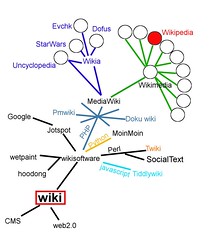
Wikis, Wikis Everywhere...

Nancy White is amazing. If you are an adult educator, you must run, not walk to a computer and read her blog. I have a Clustr map on my blog and am very happy that I have had over 600 hits. Nancy's cluster map has over 115,000 hits! In fact - all you can see is red dots representing clusters of hits - she is truly read world-wide, and often. A rare high standard for the rest of us to aspire to.

One of Nancy's recent posts is "Wikis in Plain English" which includes a very good introduction to wikis video done by Lee and Sachi LeFever of CommonCraft. The video is also available on YouTube.

I am a big believer in the power of wikis as collaborative learning tools. I use them in my courses and for my own use as well. They are a great way to get diverse groups of learners to find, share, and explain course material and content. In fact, wikis are a great way to get learners to discover and create course content, weaning them away from the expectation that it is the facilitator's or faculty's job to provide content (I do my best to provide only that content that I think is essential for the learning environment or that which might not be discovered by learners on their own). Once learners get engaged in the wiki process, they find that they are engaged in very powerful learning experiences.

The good thing is that wikis are becoming more and more universal. Wikipedia, of course, is the best known wiki, but there are many others out there that I use on a regular basis. The
Simteach wiki is a great resource for anyone involved in Second Life or other virtual worlds.

Here are some other wikis and wiki resources that I have found useful:

And here is a great article from Educause - "Wide Open Spaces: Wikis, Ready or Not" by Brian Lamb from the University of British Columbia. The article is a great summary of wikis and is also downloadable as a .PDF file. I highly recommend Educause as a source of educational articles and material.

Wikis are here to stay - what I need to do now as an adult educator is to figure out how to best use them to enhance my learners' learning environments (and my own too).

I would love to hear what anyone else has to say about wikis and what you are doing with them. It would also be great to get any wiki-related resources that you would be willing to share...

(Photo - wiki world (draft) by kaurjmeb)

Monday, May 14, 2007

Atlantic Internet Marketing Conference (AIM 2007) Day One

Today was a long, full, rich experience with lots of information passed to the attendees. The majority of the presenters gave number-heavy presentations to reinforce their positions on market penetration, changing consumers bases and practices, and a very much evolving marketing art to marketing science. One of the major themes running through out the day was that the consumer was now the hunter with the tools and technologies to find the marketers and their messages, not the other way around.

If I were to include all of the information I received today this post would go on forever, so my intent is to briefly recap each of the presentations that I attended and then conclude with my thoughts on the day. All of the conference presentations will eventually be made available.

Keynote - Yahoo! - New Methods for Online Marketing

The keynote speaker was Kerry Munro, the General manager of Yahoo! Canada. He presented a lot of facts and figures about current Internet usage and penetration in Canada generally and with Yahoo!.ca in particular. here are just a few of the numbers:
  • 58% of Canadian households are on line
  • By 2009 $16 B Can will be spent on e-commerce
  • Over 1 billion people online world wide
  • Main use of Internet in Canada by consumers is for research, not purchase
  • Yahoo! has 70% penetration - most visited site in the world (Yahoo's words)
  • 82% of Canadians have Internet access (second in world only to South Korea)
  • The Internet is 21% of weekly media usage but only 6% of the marketing budgets spent
  • Canada most engaged country in the world - average of 40.8 hours/month spent online (29.6 hours/month for the USA)
  • Canadians are not like Americans - more social, want more entertainment, humour, and sports, use more IM and downloads, higher % of women and teens. Canadians spend less per-capita online - main reason is a dearth of Canadian online merchants
  • Internet is the new prime time - from 4 PM - 8:30 PM 70% of the 12-24 age group is on line. They spend more time online than with TV, print, or radio media
  • Yahoo!.ca front page reaches over twice as many viewers as the top-rated TV show
According to Yahoo! you need the following to be successful on line:
  1. Get online
  2. Make the most of your site
  3. Market online - branding
  4. Use behavioural targeting
  5. Make the most of Web 2.0 (a very common theme through out the day)
  6. SEM (Search Engine Marketing) - searchers are engaged - 2-3 brands compared before choice made.
eBay - The Internet as Primary Customer Acquisition Driver

Presenter was Jordan Banks, General manager, eBay Canada. eBay was web 2.0 before there was Web 2.0 bringing together communities of buyers and sellers. eBay now has 233 million registered users (Q1 2007), $14.3 billion in revenue, reaches 55.4% of Internet users and has 12,416,000 unique visitors/month.

Only 14% of Canadian retailers are engaged in e-commerce. The following things have had the biggest impact on Internet marketing and marketers:
  • Broadband - it's "always on"
  • Search - can't fight disintermediation
  • Mobile - convenience rules the day
  • Social nature of the Web - ignore it at your great peril (less about content, more about engagement)
  • Personalization - make it about me
  • Distributed content - widgets etc.
The Changing Face of Marketing

Presenter was Jamie Davison, Principal, Modern Media

Now about behaviour targeting and analytics. marketing is changing from an art to a science. Thirty years ago there were 3 major TV networks, today there are 12 major media segments with thousands of choices - mass marketing approach no longer as effective. What has changed is:
  • Internet celebrities (Yuma Yuma boy, etc.) - not good content, but available on demand (Democratization of content)
  • Web 2.0 - marketing tool increases engagement - Facebook, Second Life
  • You cannot just buy people's attention, you must engage them
Who's Clicking You? Internet Attitudes and Behaviours Among Atlantic Canadians

Presenter was Layton Dorey, managing director of Research, Bristol

Authors of the Inside Out Report, Atlantic Canada's in-depth journal of public opinion. This presentation had a lot of very interesting statistics on Atlantic Canada Internet penetration and usage. Here are some of the highlights (all relate to Atlantic Canada):
  • 60% penetration
  • TV, radio, and newspaper media still strong
  • 17% in a social community - Second Life, Facebook, etc.)
  • Biggest issue is developing trust in the technology - over 2/3 of all respondents across all age groups do not trust Internet ads or click on them
  • 84% never click a pop-up ad
  • 84% watch more than 2 hours of TV per day
  • 60% spend more than 2 hours online per day
Forget 2.0... Let's Talk Web 3.0 and What It Will Mean To You

Presenter was Frederic S. Gionet, VP Innovation, Bristol

This was the best presentation of the day for me as it was the most relevant and interesting to me. To provide context, the "Christmas Carol of The Web" was presented:
  • The Stone Age - Pre-Web
  • The Past - Web 1.0
  • The Present - Web 2.0
  • The Future - Web 3.0 and beyond
Presentation highlights included:
  • Second Life was presented as an example of Web 3.0 - immersive, customizable, and engaging
  • Devices other than computers will become the dominant medium (smart phones etc.)
  • Web will be more instinctive, easier to use
  • Web 3.0 (1010/2012?)
    • Mobility including GPS
    • Internet-enabled TV
    • Domination of Web Services
    • Digital Paper - interactive/changeable ads
    • Smart Billboards/Display
    • 3d interaction and collaboration - Second Life. Bristol has an island in Second Life
    • User will be King
Integrated Inline-Offline Marketing

Presenters were Chris Keevil, President, Colour and Malcolm Fraser, President ISL

Offline media is anything not the Internet - TV, radio, print, etc.. Customers now harder to reach - due to fragmented media and a move towards personal media.
  • 1954 - 74% of families were watching "I love Lucy"
  • 2007 - 15% of families watching "CSI"
Main points of the presentation:
  • Big change in the numbers watching the top-rated TV show - marketing issue.
  • More things to consume attention now than ever before
  • Hunter has become the hunted - marketers need to be in a place where they can be found
  • Must drive traffic to your Web site
  • Web site usability is key
  • Media has changed - gather and collect information but now must also think of layout and content too
Youcasting - Communication in the Age of the Clever Consumer

Presenter was Jeff White of Brightwhite Design.

A very good presentation on the use of the following online marketing tools:
  • Viral video - companies are making YouTube amateur quality video to market themselves
  • podcasting
  • Word of Mouth - IM/chat - GMail - no advertising - just WOM invites
  • Blogging - least expensive/most time consuming marketing tool, but search engines love blogs
The key is building connections with consumers

Beyond The Internet

Presenter was Krista White, Associate Media Director, Cossette Communication Group

The last presentation of the day the focus was on video games, cell phones, mobile media, TV and out of home media:
  • Video games now out revenue movies ($10 b to $9B)
  • Average age of gamer in Canada - 33
  • In game advertising and product placement now common
  • Pizza Hut/Everquest - can order a pizza while playing the game
  • Ceel phone - adoption low in Canada (61% - Japan - 95%)
  • Texting growing
  • progressed from SMS to enhanced EMS to multi-media MMS
  • Mobile TV growing
  • Proximity-based marketing growing - infra-red communication between cell phones/PdAs and billboards/vending machines
  • ITV - Interactive TV - 8% of Domino's Pizza's orders in the UK are from ITV
  • TV viewing is not declining but commercial watching is - PVRs, VOD (Video on Demand)
My Thoughts

A very interesting day - the Internet is the marketing tool of the present and the future. It was interesting to see the knowledge of Web 2.0 and social networking and how marketing has had a fundamental paradigm shift due to the fracturing of media into so many sectors.

It will be interesting to see which sectors and which technologies truly dominate the future. It may be that the fracturing of media will mean that no one technology or media will dominate - cell phones, ITV, the Web, all will have a part to play. Can't wait for tomorrow...

Sunday, May 13, 2007

Some Web 2.0/Social Networking Flotsam and Jetsam

One of the effects of becoming immersed in the use of Web 2.0 and Social Networking tools and technologies is the sheer volume of information that I now receive daily. Between the hundreds of feed a day that I get from Netvibes and other sources, I have an ever increasing circle of friends and colleagues with whom I am sharing information and they are doing the same in kind right back at me. I would not be surprised if I was receiving more than 1,000 pieces of information a day.

Obviously that is way too much information to easily manage and utilize and I am sure that I am missing some great stuff that is just floating around out there. But on the other hand I also see a lot of stuff that I would love to spend more time with but just can't. This post collects some of that flotsam and jetsam and gives me a chance to at least briefly try to make some sense of it.
  • Politicians and YouTube - several politicians are actively using YouTube, Facebook, and Second Life among other tools, to access their constituencies at the same time that governments are banning their use by civil servants. What's that all about?
  • 2007 Web 2.0 Awards - To really see what is going on with Web 2.0, check out this site - over 200 Web sites in 41 different categories - a great way to check out the great stuff being done with Web 2.0
  • Shaping Learning Through Comments - a great post on how students are learning from comments posted to their blogs - a very effective learning tool from my perspective. The teacher here uses student blogs to have learning happen and then measures it against standards like "the student understands and acquires new vocabulary and uses it correctly in reading and writing". Very cool.
  • Can Social help in finding resources? From the Flosse Posse, this post talks about leveraging our learning communities through the use of Social Information Retrieval (SIR). SIR is described as "a family of techniques that assist users in obtaining information to meet their needs by harnessing the knowledge or experience of other users. Examples of SIR techniques include sharing of queries, collaborative filtering, social network analysis, social navigation, social bookmarking and the use of subjective relevance judgements such as tags, annotations, ratings and evaluations." This is how I am getting and sharing most of my daily information - neat to have someone put a name to it. There is a SIR workshop planned called SIRTEL 2007. Check it out!
  • Encyclopedia of Life - the Encyclopedia of Life is an an "ecosystem of websites that makes all key information about life on Earth accessible to anyone, anywhere in the world.". It's aim is to catlogue all species on Earth and have the information accessible online. This just might be the "killer" Web 2.0 app.
  • Tagging Tips and Non-Bloggy Remorse - this post is from Nancy White, who is absolutely amazing. Some tips and hints on how to keep up and manage tags while still living and working your busy life - a must read. Check out her blog and company.
  • McLuhan's Laws of Media and PLEs - from Terry Anderson (more brilliance), this post applies Marshall McLuhan's Laws of Media (Enhance, Obsolete, Retrieve, Reverse) to PLEs (Personal Learning Environments). If you are at all interested in PLEs, you have to read this post.
  • Read/Write Web Weekly Wrapup - a weekly wrap up of all things Web 2.0. You can subscribe and get the weekly feed. A great way to get a manageable digest of what's happening with Web 2.0 tools and technologies
I know there are literally thousands of other bits and pieces out there. Hope that some of these will be of use. Now, it's time to fire up Netvibes and get the next flood of information...

(Photo "Flotsam and Jetsam" by RobW)