Saturday, April 21, 2007

Games Don't Kill People, People...

I've been agonizing for a few days now about whether or not to even write this post or not as by now we have all become massively overwhelmed by the tragic events at Virginia Tech, and the tidal wave of media coverage that has battered us all week. But I have something I want to say, so please bear with me.

What happened at Virginia Tech is a tragedy beyond comprehension, the act of an insane monster, whose motivations and actions are beyond me. But what has happened since Monday has, in my mind been equally as tragic. That happening is the constant, all-consuming media coverage that has taken and created a media cottage industry, and I find it reprehensible. Why is that CNN and the other private broadcasters in North America (the US networks and CTV and Global in Canada), felt the need to trot out for our consumption every canned "expert" that they could find to analyze, go over, rehash, and flog to death the events at Virginia Tech. It was nothing short of a visual and auditory assault, particularly when they broadcasted the murderer's "manifesto". Talk about your 15 minutes of infamy - he is going on 6 days and counting.

But the item that has really hit home for me s the crazy notion that it was video games that drove the killer to do what he did. There is absolutely no evidence that he was a gamer yet "experts" like Dr. Phil on Larry King Live blame video games for the actions of a madman. What about gun laws that allow unstable individuals to legally purchase hand guns, to buy large capacity magazines (in one report the killer was thought to have had 30-round magazines and fired nearly 200 rounds), and hollow-point bullets that are designed specifically for maximum lethality?

As an educator who sees the values of games and gaming as learning tools for engaging the current generation, my job has now become that much more difficult when I try to propose the innovative use of games in my professional practice. Why is there this insatiable need for mainstream media to go on and on about a tragedy, employing so called experts as talking heads to fill in their airtime? Why cannot they just report the events like they are supposed to and then give people the time and the privacy they need to heal?

I don't have the answers, but I do know that the media has to stop their current tactics of inundating us with microscopic details about what has happened - no wonder there are copycats.

To end this on a positive note, please check out my friend Carolyn's blog post "What's Your Secret?". It's an amazing video done by a group of students from my college - it's worth a look and for me puts some perspective on this past week's events. A good way to end...

Sunday, April 15, 2007

Randommind - A Must Read

My good friend Carolyn blogs on all sorts of things educational in nature and more. She has great insight into education, learning, instructional design, Web 2.0, Second Life and lots more and has a great knack for finding the most amazing stuff from the Web and the blogsphere.

Check out the Randommind blog - she has some great things to say.

Stanford Humanities Lab's How They Got Game Workshop - Second Life

This is a video From the Stanford Humanities Lab’s How They Got Game Workshop with Linden Lab’s Director of community affairs Daniel Huebner.


It's a great discussion on the background, history, philosophy, present, and future of Second Life. It's over an hour long, but really worth a view if you are interested or involved with Second Life, so put on a fresh pot of tea and get comfy...

(Video from Google Video)

Saturday, April 14, 2007

What Do You Mean It's Been Blocked?

The following was posted on Slashdot by Londovir:

"Recently, our school board made the decision to block Wikipedia from our school district's WAN system. This was a complete block — there aren't even provisions in place for teachers or administrators to input a password to bypass the restriction. The reason given was that Wikipedia (being user created and edited) did not represent a credible or reliable source of information for schools. Should we block sites such as Wikipedia because students may be exposed to misinformation, or should we encourage sites such as Wikipedia as an outlet for students to investigate and determine the validity of the information?"

In another case, the history department at Middlebury College in Vermont has banned students from using Wikipedia as a research tool. There are all sorts of other articles, news items, and Web sites full of stories of Wikipedia and other social networking sites like MySpace, Facebook and others being blocked or banned by K-12 school systems and post-secondary institutions.

In most case the rationale for banning these sites is that Wikipedia and other similar information sites are full of inaccuracies and errors because they are user created and edited. As for the social networking sites the reasons given are that they distract learners, are time wasters, and expose them to potential predators and other unsavoury individuals.

So, are these rational, informed decisions made to improve learning environments and protect learners, or is it the 21st century equivalent of book burning? While I think that the people who made the decisions to block sites believe that it is the former, I tend to see it as the latter - uninformed, unaware, scared people making quick, knee-jerk reaction decisions.

As for the inaccuracies and errors found in Wikipedia, several studies have shown that it is no less accurate than the printed version of the Encyclopedia Britannica, found in just about every school, college, and university library. When an inaccuracy is found in Wikipedia, it is fixed much faster than it would ever be in a printed version of any reference text or encyclopedia.

But for me the bigger issue is why block these sites at all? Isn't one of our responsibilities as educators to give our learners the skills to gather, analyze, and interpret the information they find. Wikipedia or a similar social networking reference site should never be the sole source for information, but it is a great place to start. Learners should develop the skills and knowledge to determine for themselves the accuracy of the information they find, regardless of its source, and as a source Wikipedia is better than many.

While blocking MySpace, Facebook, and other social networking sites may create an illusion of learners having more time in school to pay attention and be engaged in learning, it's just that - an illusion. They will be no more engaged in learning at all. What we (and parents) need to is educate learners on how to be socially and personally aware in an ever-increasingly social Web. Get learners to use social networking sites for positive, beneficial experiences - there are a lot of great things offered by these sites. I use Facebook for example to create and maintain alumni contacts with former learners - this informal social network has resulted in job and other opportunities for my current learners. Teach them the tools to be wise and safe when they are online. Blocking and banning sites will only make them more attractive and will result in uninformed and unsafe use.

So - no more knee-jerk blocking of sites OK? Take the time to understand the tools and technologies before you light up the bonfire. In the long run you will be doing everyone a great service...

(Photo - "fahrenheit burn" by mrtwism)


Blame It On Friday The 13th


(Photo by procsilas)

Ever have one of those days? You know the ones I mean - you wake up (late), get dressed, wear your breakfast, get changed, rush out to the bus (you are even later now) into a snow/rain storm (forgot the umbrella but will miss the bus if you go back for it), get wet, get to work and then the day gets worse? Computer glitches, coffee pot goes on the fritz (OMG - what do you mean there's NO caffeine?), and you get swamped by work and none of it goes well? You misunderstand everything people are saying to you, and that meeting you were supposed to be at started 30 minutes ago without you? Then you wear your food at lunch - (white shirt + tomato sauce = law of physics), and the afternoon goes just as poorly as the morning? You know - it's one of those "I should have stayed in bed days".

Well I had one of those days yesterday, but guess what? It wasn't my fault - it was Friday the 13th's fault. The PsyBlog has an intersting post "Is Friday the Thirteenth Unlucky?". In it the many origins of Friday the 13th are mentioned as are several research studies both supporting and debunking the notion that Friday the 13ths are unlucky. No definitive conclusion is stated, but after the day I had yesterday, I can tell you first hand that Friday the 13th is unlucky. I mean none of yesterday's disasters could actually be my fault. Could they? Hmmm...

Friday, April 13, 2007

Research 2.0

As we start to move more and more to an online world, we spend more time doing research and finding information on the Internet and through other electronic stores of information. This video, titled Research 2.0, discusses the issues of doing research in an online electronic world, including the pros, cons, pitfalls and advantages.


Thanks very much to my friend and colleague Lana, who originally passed this video on to me.

Lots to think about. Hmmm...

Wednesday, April 11, 2007

Which Serenity Character Are You?

Thanks to my friend Leah for this one. Here are my results of the Serenity personality test:

You are Malcolm Reynolds (Captain)
Malcolm Reynolds (Captain)
75%
Derrial Book (Shepherd)
70%
Dr. Simon Tam (Ship Medic)
70%
Zoe Washburne (Second-in-command)
55%
Wash (Ship Pilot)
55%
Jayne Cobb (Mercenary)
50%
River (Stowaway)
45%
Kaylee Frye (Ship Mechanic)
40%
Inara Serra (Companion)
35%
Alliance
35%
A Reaver (Cannibal)
0%
Honest and a defender of the innocent.
You sometimes make mistakes in judgment
but you are generally good and
would protect your crew from harm.
Click here to take the "Which Serenity character are you?" quiz...

Firefly was one of my favourite TV shows and Serenity was recently voted the best sci-fi movie of all time in the UK, beating out all of the Star Wars movies. Hmmm...

Sunday, April 08, 2007

Is There A Classroom In My Future...?

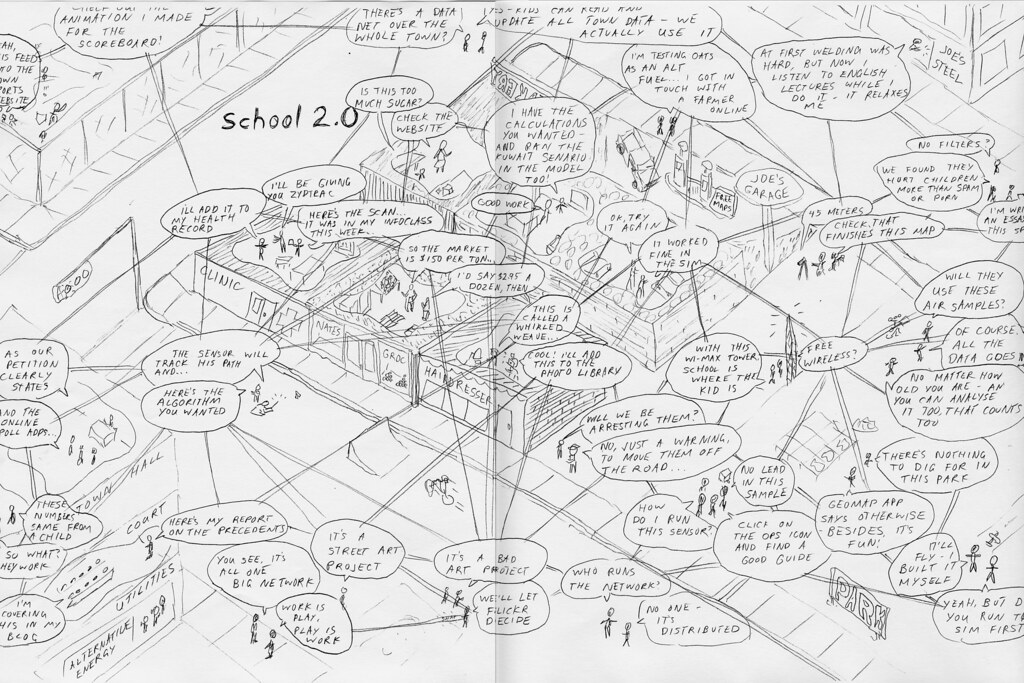
Stephen Downes is an amazing guy. He works for the National Research Council (NRC) in Moncton, New Brunswick where he specializes in online learning, content syndication, and new media. He also produces the OLDaily newsletter (subscribe TODAY!), and has several blogs including "Half An Hour" where he writes about various educational and technology topics. If you are an educator, you MUST consider Stephen's writings as required reading. His insights and opinions are thought-provoking and provide clarity in what has become a very complex field.

In one of his recent posts, "To The School Or Classroom 2.0 Advocates", he makes the point that:

"technology allows us to change our approach to education, from one where we segregate learners in specially designed education facilities (classrooms, training rooms, schools, universities) to one where learning is something we do (and what educators provide) in the course of any other activity.

The idea is that 'School 2.0' is the first step toward being non-school, and that our objective should be to use technologies to leverage our ability to personalize learning, and in so doing, facilitate students' learning while taking part as full citizens in the wider community."

This really struck a chord with my own beliefs of the future of adult education (although I will concede that this could apply to K-12 as well). What I think Stephen is describing is personal Learning environments of PLEs, an individualized and customized approach to learning that I think is the future of adult education and our role as educators. PLES will provide learners with greater opportunities for learning success as they will permit learners to learn within an environment that will maximize their learning as it will best suit how and what learners learn.

Stephen goes on in his post to talk about the future of schools and classrooms - schools and classrooms are a creation of the industrial age. This makes a lot of sense to me - schools and classrooms are really just another type of factory - the product is knowledge (and hopefully learning, but this isn't always the case). So what are the implications for me as an adult educator? I think that the main one is that I need to be ready and able to help learners create their PLES and as we move more and more towards "Education Without Boundaries" (one of the key tenets of my college's strategic plan), I have to be more adept at existing in traditional classrooms, blended deliveries, online learning and learning environments not yet thought of. Don't get invested or stuck to the delivery location or method - be dedicated to the learning.

Stephen makes another point that struck home for me:

"Educators need to realize that today's students are exposed to much more television, online communication, and other electronic communication, than they are to traditional classroom instruction. School, even as it is, makes up only a small percentage of their learning. It plays virtually no role in values formation, culture and self-identification, language learning and art. If school provides any learning of science, mathematics, geography and history, it is only because the students' cultural environment is almost completely bereft of those subjects. Their performance in those subjects - and especially the latter two - shows just how abject their learning has become."

Boy does this explain a lot about my learners when they first come to the College. We need to find ways to bridge the gaps that learners have as a result of their school experiences. Stephen suggests offering students limited full-time employment while still in school. Hmmm...

Amazing stuff Stephen, thanks for sharing with us.

(Drawing - School20 By Stephen Downes)

No Reason - I Just Like the Picture

We had a "Frozen April Shower" here last night, with about 20 cms of snow. It is my constitutional right as a Canadian to mutter under my breath about the weather, but I thought that for a change I would take the high road and not do that. Instead I just posted a picture I took (with some tweaking courtesy of Paint Shop Pro) of the snow falling. No real reason - I just like the picture.

Reading, Writing,...Hey! - What About The NEW Literacy Skills?

OK, we are all acquainted with the 3Rs - Reading, Writing, and Arithmetic. They have been the foundation of our educational system for, well forever. Unfortunately I think that the foundation is cracked. A large majority of the learners I see coming out of the K-12 system lack the literacy skills in reading, writing, and arithmetic to be successful at the post-secondary level. So much so that we spend a lot of valuable time during the first year of their diploma programmes trying to improve these essential skills.

But it's not as simple as just improving the 3R literacy skills and it's about to get worse - there are a whole new set of literacy skills that are just as important or in some cases more important for learners to be successful in this new information age. From my perspective we have to add the following skills to the set of basic literacy skills needed by all learners beyond the 3Rs:
  • Typing
  • Information gathering
  • Information analysis
  • Safety and security
  • Privacy
If you lack typing skills in the ever-increasing synchronous (and asynchronous) online world, you cannot communicate. If you cannot communicate, you will have difficulty learning. E-mail, chats, IM, games, virtual worlds - they all require an ability to type to keep up with and follow multi-threaded conversations - typing is the new talking.

The Internet has become the single largest source of information ever known to man - the amount of information is staggering and learners need to not only know how to find information, but how to analyze it for veracity and accuracy as well. These two skills are just as important (or more so in some cases) than reading and writing are. If information cannot be found, and analyzed for accuracy, relevancy and currency, then learning will not happen.

Learners (all users of the Internet actually) need to have skills that will keep them safe and secure. Security of personal information, who to trust, what to reveal about your self are all important issues as we move forward in an increasingly Web-centric educational world - this also ties into Privacy skills - what should be private, and what should be public is an essential and basic question that every user of the Internet must answer. In order to answer that question, learners must have the skills to make informed decisions about their online presence.

So what can we do as educators? We cannot ignore the 3Rs - they are still required skills, but we must also be aware of the the "new literacy" skills as well. If our learners are not adequately prepared and practiced in all of these literacy skills, how can they truly be life-long learners which is ultimately what as educators we are preparing them to become? Hmmm...

(Photo - Keyboard ~ Blur by Striatic) (Photo - Reading by Maxey)

Tuesday, April 03, 2007

Managing Information - Turn Off The Fire Hose!!

I suspect that we are all suffering from information overload, or as I like to call it - drinking from the fire hose - you get to swallow a little bit of information - the rest just gets you wet.

This was brought home to me this morning when I asked friends if they got my e-mail. The answer was "which one?" followed quickly by "turn off the fire hose!!". I was overloading them with information and not doing a very good job of even telling them what information I was even talking about.

So how do we manage information in this age of always on Internet, TV news, radio, and print media? I know that my information gathering patterns have changed significantly over the years from print to audio, to video (TV), to print again (the early Internet) and now to constantly streaming pushed multimedia content (Web 2.0) that I get to customize myself, creating an information nirvana for a data junkie like myself. I must receive on average over 200 e-mails from different sources (and with multiple e-mail addresses of course), although I will admit to merely reading the Subject lines of the messages and filtering out the ones of no or little interest (or the duplicates) to my Delete folders.

And then there is my latest information goldmine - the RSS aggregator - with Netvibes I am now receiving hundreds of feeds a day. Again I am mostly looking at titles and synopses and reading only the ones I think are relevant to my interests. On top of all this e-mail and RSS information, I read the newspaper every day, watch TV news, and get information sent to me by my friends - no wonder I always feel a little damp around the edges...

I tend to share what I find with friends and colleagues. The problem is I get carried away with my own enthusiasm and turn the fire hose on full, and everyone is just too busy to go around wet all day. How do I share what I think is neat, cool, essential, or just plain hmmm... information? My filtering system seems to work for me (or am I just kidding myself and missing more than I find?). So is it blogs, RSS aggregators, Google Groups, or some yet to be seen Web 2.0 "killer app" that will let me share the information I find and not get my friends (or myself) drenched by the information fire hose? Any thoughts, any ideas?

Hmmm...

Sunday, April 01, 2007

Blog Power Redux - Some of My Favourites

If you look at my blog archive, you can see that this whole blogging thing has really started to gain momentum with me. Not only am I writing posts, I am using other people's blogs more and more as information sources. There are many blogs that I now read on a regular basis and I thought that I would share some of them with you. So here, in no particular order (actually grabbed from my Netvibes tabs) are some of my favourite blogs and their authors (bloggers?). Check them out for yourself:
As you can see a long and varied list focussed primarily on technology, education, Web 2.0, and Second Life. Check these out and if you have a favourite blog or two (or ten) let me know about them. Share the wealth...

(Photo from Kosmar)

Saturday, March 31, 2007

My Web 2.0 Toolkit

I've been exploring and using all sorts of Web 2.0 tools and technologies for some time now and thought I would share the ones that make up my "Web 2.0 Toolkit". These are the Web 2.0 tools that I use pretty much everyday in both my personal life and as an adult educator. So, in no particular order, here they are:
  • Blogging - Well - I'm obviously using Blogger, but Wordpress is pretty cool too
  • RSS - I'm sold on Netvibes - it's become my number one source of online information - I literally get hundreds of feeds from it daily
  • Pictures - Flickr and Photobucket. I use Flickr for storing and showing off my photos and Photobucket for my stock photos that I use on line. I also use flickrCC to find stock photos online (remember to abide by the licensing terms of the owners - msot use one of the Creative Commons licenses)
  • Wikis - I have several different wikis now at wikispaces but pbwiki is a really good tool as well. Wikis are a great educational tool, particularly if you get your learners to maintain them. A good way to answer the question "What do we do now that the course is over?".
  • Collaboration - Google Groups and Google Notebook. Two great tools from Google, I plan on using them to replace textbooks in my courses.
  • To-do List - Remember The Milk is an easy to use to-do list that keeps me on track
  • Calendar tool - Google Calendar - just about runs my life now, would be lost without it - and I can share my calendar too so people know what's going on with me.
  • Social Networking - Facebook - a great tool for staying in touch, I'm in the process of setting up an alumni group for my former students
  • Video conversions - Vixy.net is great if you absolutely must have a local copy of that favourite online video. A great tool if you don't always have a high-speed Internet connection
  • Staying current - Twitter is a great tool for letting people know where you are and what you are up to although I do not use it nearly as much as some. I actually use the custom status messages in GMail more
  • Conferencing - Elluminate's vRoom - a great free tool from Elluminate gives you all of the capabilities of Elluminate except for recording and a limit of three sites. Not really a Web 2.0 tool (try Vyew if you want a Web-based conferencing tool).
Well there you have it - my current Web 2.0 toolkit - I am sure that it will continue to evolve over the months to come and I'll do my best to let you know what I am using...

(Photo from David Babylon)

Third Life

This is a great ad from the Netherlands (a country well represented in Second Life) for Kit Kat bars. It answers the question - "What does your avatar do for fun when you aren't around?"

Friday, March 30, 2007

The Term paper IS Dead

How many term papers have I written outside of academic settings in my life - ZERO!!! How many times have I taken multiple sources of information and synthesized a report, briefing, or presentation - I've lost count. So - should i be getting my learners to write single subject term papers or should I be helping them develop the skills that they will have to use in industry - to be able to find, verify, assimilate and produce work from multiple information sources and types? Hmmm...

The Washington Post has an interesting article on the subject that has prompted this blog rant. The article, "Cut and Paste Is A Skill Too" by Jason Johnson, makes the point that while plagiarism is on the increase and many institutions and educators have instituted systems to hunt down the plagiarists, "it is important for learners to be able to synthesize content from multiple sources, put structure around it and edit it into a coherent, single-voiced whole.

Students who are able to create convincing amalgamations have gained a valuable business skill. Unfortunately, most schools fail to recognize that any skills have been used at all, and an entire paper can be discarded because of a few lines repeated from another source without quotation marks."

(In fact I just cut and pasted most of the previous two paragraphs from the article - so did I plagiarize it - or do the quotation marks save me? Hmmm...)

Learners today are exposed to instantaneous information from multiple simultaneous electronic and other sources, not to mention the "traditional" sources of books, journals, magazines, newspapers, etc. (assuming any of them read paper-based words anymore). They are swamped by the sheer volume of data they they are exposed to and asked to make sense of most of it on the fly. One essential skill required by our learners is the ability not to just source information, but to determine its veracity. These pressures can lead to the "easy way out" of cutting and pasting information that they find, most times without citation or attribution.

So what are we as educators to do? We need to do what is suggested by Jason - "acknowledge what the paper is today: more of a work product that tests very particular skills -- the ability to synthesize and properly cite the work of others -- and not students' knowledge, originality and overall ability." Let's get creative and have learners engage in activities that do reflect their knowledge originality and overall ability. Stress the applied learning, not the theoretical.

Show me what you can do, not what you know (oh and make sure that you do give attribution, credit, and due acknowledgment to the sources of your information - it's the right thing to do) - demonstrate your competencies and learn to learn - that will prove what you know better than any term paper ever will.

I rest my case.

(Photo from everdred)

Is Second Life a Game or...

I have been active in Second Life (SL) now for about 10 months. In that time I have come to see great potential in SL as a social networking tool, as an educational environment, and so much more. I have seen things and been to places in world (that's SL-speak BTW) that I could not have done in the "real world (RL)". I have met people from all over the world and have made many friends that I think of no differently than my RL friends even though all I have met is their avatars. There is a vibrant and growing educational community in SL that is doing some amazing things. There are artists, entertainers, entrepreneurs, and ne'er do wells in world. In many ways it emulates the RL, with the good, the bad, and the ugly that any society has.

But the nagging question is this - is Second Life just a game or something else? Is it a virtual reality with a real economy employing a lot of people and allowing many to get rich? Is it a place where people can be anyone or anything and do anyone or anything? Is it a great place to learn, to collaborate and communicate with educators and learners from around the world? It is all these things and more, but is it a game?

Clark Aldrich has an interesting post on his blog - "educational simulation". He defines an educational simulation as "A type of sim that brings together significant simulation elements and pedagogical elements with limited Game Elements." He then goes on to describe how educational sims differ from games in that they:
  • Are built primarily to nurture specific learning goals in participants (called students or learners), often with real-life actions reflected in the interface.
  • Often are supported by human coaches/facilitators.
  • Tend to have lower production values than complex game.
  • Focus on replay using different approaches.
  • Are often chosen or paid for indirectly by program sponsors, not the participants themselves.
  • Come in specific genres including branching stories, game based models, interactive spreadsheets, virtual labs, practiceware, just to name a few.

Yet like with all simulations, educational simulations:

  • Require participants to necessarily develop skills, and do so through emergent learning.
  • Can be single player, multi-player, or massively multi-player.
  • Are built around levels.
  • Will appeal to some people and not others.
  • Focus on what actions are available, how the actions impact systems (including units, maps, and processes), and how those systems then produce results, often presented in a practice environment.
  • Are surrounded by multiple communities.
  • Are first described in design document, before programmed, debugged, and distributed.
  • Can be complex or mini
(Many thanks to Clark Aldrich for this great definition - check out his blog - it's a great source of terminology and other educational resources for all things dealing with simulations and Web 2.0)

If you examine Second Life using these requirements and features, I think it is safe to say that SL is indeed an educational simulation. But is that all it is? No, it is so much more, and yes, at some level it is a game. But to simply dismiss Second Life as a game is to miss an incredible opportunity for learning, commerce, socialization, and so much more. Anyone who does this risks missing out on what could be a wonderful experience for them and their constituencies.

Maybe we need a new description for Second Life - it's not a game, it's not a simulation - it's a parallel synthetic reality - one more universe in the ever growing multiverse. Hmmm...

Thursday, March 29, 2007

Blog Power and Other Things

It's been a good day for Blog Power...

One of my fellow faculty members has just been selected to attend Microsoft's Tech Ed 2007 conference June 4-8 in Orlando. While attending a conference is not that unusual, the manner in which he has chosen to report on the conference is. He plans to blog and use wikis to keep us all up to date on his preparation, attendance, participation, and after action. This is not new in the world of the blogosphere, but is pretty new to us - very cool. I think it will have a major impact on things here at NSCC.

Robert Talbert is an associate professor of mathematics and computing science at a small liberal arts college in the Midwest who writes the Casting Out Nines blog. He has a recent post "Escaping Textbooks" that is near and dear to my heart. He is in the process of developing a textbook-free course in Modern Algebra and already has a textbook-free problem-solving course which intrigues me as I also teach a Logic and Problem-Solving course. More importantly he will be blogging his course development process. I'm really looking forward to following along.

One of my students read my earlier post about not using textbooks "My Next Textbook - Google Notebook", and has decided to create a Google Notebook of common Visual Basic syntax and structures that he will share with his fellow classmates. Very cool.

I'm now exploring the use of Google Groups as a collaborative learning space/resource repository and will be running all of my courses this Fall using blogs, wikis, and other Web 2.0 tools to support learning and foster engagement. I have been greatly encouraged to do this by the generosity of other travellers in the blogosphere as they share their educational experiences through their own posts.

All in all, a VERY good day for Blog Power...

Wednesday, March 28, 2007

Engagement - It's Very Commons


No, that's not a typo in the title, although those who know me would suspect that as I can make Mavis Beacon weep. Just be thankful I DO know who Mavis is or it would be really painful reading this.

No, what is on my mind today is Learning Commons. I had the privilege today of conducting, with a colleague, a workshop at an Open House held at the the Pictou campus of the Nova Scotia Community College (I am faculty at the Institute of Technology campus in Halifax, about a 90 minute or so drive from Pictou). There are 13 campuses all told in the NSCC system.

The Pictou campus has been renovated in the past couple of years and now has a learning commons at the front of the building by the main entrance. It is a central location, almost the hub of the campus where students can congregate - spun off of it almost like the arms of an octopus are the campus bookstore, Centre for Student Success, and the other administrative and support services of the campus. Talk about one-stop shopping!

As you can see it is full of activity with students engaged with each other about what they are doing. I love the idea of a learning commons, a space for students to be with other students, to relax, to study, to talk, but most importantly to learn from each other. Students from different programmes can cross-pollinate with others and get a much richer educational experience. Students really are each other's most valuable assets and having a learning commons allows them to exploit this resource to the max.

The IT campus where I work is commonless at this point in time, there is not really a similar place where students can gather like they can in a learning commons - I cannot wait to see the impact of a learning commons on my campus, when it comes...

Saturday, March 17, 2007

The Kings and Queens of Battle


In military tradition, the Infantry is known as the "Queen of Battle". It is the infantry that takes and holds ground and destroys the enemy. The other combat arms and supporting arms are there to support the mission of the infantry.

Eight Nova Scotian infanteers and other soldiers have died in Afghanistan out of 46 Canadians who have paid the ultimate price. They are for me the Kings of Battle. That's 17 % of the fatalities from a province with about 4% or so of Canada's population. Nova Scotia has always had a grand military tradition, one that continues to this very day and is reflected in the inordinately high casualty rate from Afghanistan.

The current rotation of Canadian soldiers in Afghanistan are formed around 2RCR based in Gagetown NB, augmented by Reservists from the four Atlantic provinces. This week the first funeral for an Atlantic Canadian Army reservist killed in Afghanistan was held in Stellarton. Cpl Kevin Megeney was a member of the First Battalion Nova Scotia Highlanders (North) (1 NSH(N)), a unit with a long and glorious military history. I had the honour and privilege of serving as an Army Reservist in Nova Scotia for 28 years, and over those years spent a lot of time with members of 1 NSH(N). The regiment is your family and more and I know that the whole regiment is in mourning for the loss of their comrade and brother in arms. My condolences go out to Cpl Megeney's family and to all the members of 1NSH(N) past, present, and future who have had and will have the honour of counting Cpl Megeney as one of their own.

Shakespeare got it right when he wrote "We few, we happy few, we band of brothers; For he to-day that sheds his blood with me shall be my brother".

Thank you Cpl Megeney for your dedication, your service, and your sacrifice. You will be remembered.

Sunday, March 11, 2007

What Came First? The Chicken or the Computer?


I've been involved in a lot of conversations lately about technology and people. These conversations have revolved around the topics of technology, education and people, and more importantly for me, technology education. As an IT faculty member do I teach technology or do I teach people to use technology, or do I in fact teach something completely different?


I have also been reading Guns, Germs, and Steel by Jared Diamond (W.W. Norton and Company New York and London, 1999 ISBN: 0-393-31755-2) He comes to the conclusion that "technology develops cumulatively... and that it finds most of its uses after it has been invented, rather than being invented to meet a foreseen need." (pp245-246). So technology develops as it is used, by the people who use it.

To add fuel to the fire I have been talking a lot to people about online course development and the use of Web 2.0 technologies in traditional (brick), blended, and online learning environments. One of my wise friends has clearly stated that "instructional computing is about people, not technology". He has been preaching this for over 30 years and I believe what he says. I have forgotten more technology than I know, and still believe that I am a good technology instructor. I believe that I am a good technology instructor because, in fact, I do not teach technology, I teach people how to learn and how to use technology. Technology supports learning and learning allows people to not only use technology but to think up those uses of technology that have not even been thought of yet. Many of the jobs my graduates will be doing 10 years from now have not even been created yet, let alone the technology that they will use. So as a technology instructor it is my obligation to give them the skills and knowledge to learn, to use technology, and to push its boundaries, but it is NOT my place to simply teach technology.

What does this mean? Well for one thing it means that I should never focus on a particular piece of technology as the be all and end all of my teaching practice. I teach programming and right now I happen to be using Microsoft Visual Studio 2005 to do it with. What I am doing (or I hope that is what I am doing) is teaching programming principles, skills, and knowledge that are transferable to any programing environment - the learning of Visual Studio is a happy by-product. The same applies to the use of Web 2.0 technologies - the emphasis must be on the people, the social aspects of the tools, the change in how information is gathered and shared, not the tools. So as I go forward and explore new technologies and tools I remind you that at the end of it all - it is the people, not the technology that we are here to support.

So it WAS the Chicken that came first...

(Chicken photo from Mark Lorch) (@ photo from borabora)

Sunday, March 04, 2007

Presents? Oh... You Said "Presence"!

I've been in Second Life now for about nine months or so and have become convinced that it has great educational potential. Part of the reason why I think this has to do with presence (and not presents unfortunately).

The two most common ways of communicating in Second Life are chat (public and local) and IM (private and across
the grid).These are also two of the most common ways that we communicate in the current suites of online course tools - LMSs, CMSs, etc.. But there is something different about chat and IM in Second Life. It does not feel (to me anyway) to be as disembodied or remote as it does in Moodle, Blackboard, or a similar online learning environment.

Part of this is, I believe, a direct result of the visual nature of Second Life, but more importantly its immersive nature. Ask anyone who has spent any time in Second Life and they all comment on how fast time went by - it is an immersive, experiential environment and your avatar gives you presence that does not exist in other online learning tools (yes I believe that Second Life is an online learning tool).

So is presence important in learning? Does all learning have to be face-to-face in order to work? I think that the answer to the first question is yes, and the answer to the second one is a definite no. There are all sorts of examples of very successful online learning opportunities, and legions of happy learners to prove it. But does presence add something to the experience? That is the question that needs answering. I certainly believe that it does, but I have no proof other than my own opinion and experiences and that of several like-minded friends and colleagues.

If presence does add to a learning environment, what are the implications for us as adult educators? How will we have to offer online learning opportunities if we need to have presence? Will Second Life and similar MUVEs spell the end of the current crop of LMS and other online learning systems? Will future online learning environments include a visual component to add presence? Can there be presence without a visual interface? Hmmm...

(Photo from BunchofPants)

Sunday, February 25, 2007

My Next Text Book - Google Notebook

I have seen my next text book and it's Google Notebook. If you are educator using any online resources you need to check this out (run, don't walk to the nearest computer). Google Notebook allows you to create and share "notebooks" - and with the available Firefox extension, it's simple to add content from any Web page (and yes, remind your learners about copyright, intellectual property, attribution, and the Creative Commons licensing types). All content in a notebook can be edited and updated as well. Web 2.0 at its best.

I see using a Google Notebook like this:
  1. Create a notebook, either on a general course title or a specific topic
  2. "Seed" the notebook with whatever required information you see as important for your course
  3. Make the notebook available to your learners, making them responsible for its maintenance
  4. Use the notebook to augment/replace text resources
  5. At the end of the course you have a collaboratively created resources that is much more relevant to your learners than any text book could ever be
There you go - a current, topical, no cost alternative to expensive, heavy, out-of-date text books. I can't wait to try it out...

Is E-Mail Dead?

I recently asked my learners if they could only have one of either e-mail or instant messaging (IM), which one would it be? The answer across a total of more than 120 learners was almost unanimously in favour of IM.

When I asked them why they made their choice, I got several answers:
  • "E-Mail is too slow..."
  • "IM is more like a real conversation..."
  • "I always get an answer with IM. Some people ignore e-mail.."
  • "IM is easier to use..."
  • "It's easier to share files with IM..."
  • "IM is on every computer. My E-Mail client isn't..."
Interestingly enough, I have always seen e-mail as an asynchronous tool, and IM as a synchronous one. Many of my learners actually use IM in an asynchronous manner, leaving it open all the time and getting back to a conversation when they can. This use of IM was reinforced by a friend of mine who has told me that her children so the same thing.

The lack of immediacy and not knowing if anyone was there at the other end of the "conversation" seem to be the two biggest reasons why e-mail is falling out of favour. Now that there are secure, business quality IM systems on the market , it will be interesting to see if e-mail is truly a technology that will go the way of the dodo, to be replaced by the more immediate and intimate IM tools. Hmmm...

Saturday, February 24, 2007

Tag! You're It...

As I continue to look at all of the new tools and technologies that are cropping up all over the Web, I 'm trying to figure out what exactly makes a Web 2.0 application a Web 2.0 application. Is it user customization, social networking, sharing and modifying information, or something else?

The one common thing that I have seen in most of the Web 2.0 applications that I have looked as is tags - the ability to categorize or group what you are doing so as to make the information produced easier to share and find.

So, is it valid then to say that in order to be a Web 2.0 application, tags must be used? While not all inclusive, I think it's a valid "litmus test", and a way to identify something as being Web 2.0. Here are just a few Web applications that use tags. You can decide if they are Web 2.0 or not:
And I know that there are many, many more... Which ones are your favourites?

Saturday, February 17, 2007

A Pilgrim's Web 2.0 Progress

It's been some time now since I began exploring the use of Web 2.0 tools and technologies. Here are the tools I've used so far and what I think of them
  • NetVibes - a RSS aggregator and so much more, NetVibes literally has thousands of feeds, module, podcasts, events, and tabs that you can add to your own to create an amazing "learning Portfolio" of customized information. You can also share your feeds etc. with others through NetVibes ecosystems. My favourite Web 2.0 tool by far, I will be using NetVibes in my learning environments in the future.
  • Blogger - If Blogger isn't your favourite blogging tool, try Wordpress, several of my friends use it. Blogging has to be the most powerful Web 2.0 tool, and is probably the most used one. I will be using blogs with my learners in the future.
  • Wikispaces - one of many sites that allow you to create your own wikis, I am using wikispaces now with learners to create custom learning spaces online. Wikis are a great educational tool and they add to the collaborative nature of any learning environment, particularly if you have the learners maintain the wiki.
  • Flickr - I'm into digital photography, and Flickr is a great way to organize and share my pictures. It also has potential as a learning tool through the creation and display of slide shows and picture collections (and I am sure all sorts of other ways that I haven't thought of yet). My Flickr collection is here.
  • Second Life - not strictly a Web 2.0 tool, Second Life has incredible educational value through experiential learning, service learning, and simulation (among others). I think that the use of Second Life is limited only by the imagination of the users.
  • Yahoo Pipes - I've just started looking at Yahoo Pipes, but I love what I've seen so far. As Yahoo says you can use Pipes to "rewire the Web" creating custom mashups, allowing you to create your own custom view of the Internet. I think that this tool has great educational potential and I will be exploring it further.
  • Remember The Milk - allows you create and see online tasks and to-do list that you can keep private or share. Would be a useful online tool for keeping track of course deliverables due dates.
  • Eventful - tracking and creation of events in your neighbourhood and around the world, eventful has some educational use for tracking and reminding learners of events, conferences and important academic dates
  • Boxxet - another tool that allows you to create customized "box sets" of feed and information. It has loads of pre-built boxxets or you can create your own.
These are the main tools that I've been exploring, but I have also taken a look at several others that could prove useful to you. These tools are:
  • Suprglu - an aggregator like NetVibes, it allows you to create your own custom view of the Internet
  • Your Minis - like NetVibes you can create custom tabs of feeds and widgets
  • Vyew - collaborative conferencing similar to Elluminate. We currently use Elluminate, and Vyew has much the same look, feel, and capabilities
  • Photobucket - a photo storing, organizing, and displaying service like Flickr
  • Vidavee Graffiti - a tool that allows you to markup and customize the appearance of videos
I've looked at many tools as my meandering Web 2.0 journey continues, but these are the ones that have left an impression with me. One thing that I have concluded so far is that with Web 2.0 tools you need to select the ones that work for you and use those, not try to use them all just because they are there. The journey continues...

Tuesday, February 13, 2007

If a Blog Falls...

Todays cartoon at bLaugh raises a good point. If no one reads your blog, does it matter? Is it even a blog or just unheard and unseen ramblings? Hmmm...

If a Blog Falls

Saturday, February 10, 2007

Sit Still While I Instill

This question was posed to me last night - "How do education administrators help faculty and students break the habits of stereotypical F2F classrooms (”you sit still while I instill")?"

So how do we? is it the place of administrators to do it? If it is how do they do it? Hmmm...

I'm going to start from the premise that the days of the "sage on the stage" have been replaced in adult education by the "guide on the side". We facilitate learning. I certainly know that is true in my practice. More and more my job as an adult educator is to help learners learn to learn as much as it is to "teach" any particular piece of content.

Breaking the habits of the F2F classroom is difficult for both faculty and students - it is all that many of them have ever known, and it is safe and predictable. As a learner I simply have to sit there as an empty vessel waiting to be filled with knowledge - no fuss, no muss, and not a whole lot of effort on my part.

Well sorry to tell you learners, but those days are over - you are responsible for your own learning and it takes work. We will help you learn, but ultimately it is your choice whether you do or not.

To help you learn we need to be creative, get out of our own "silos" and get support from our administrators that allow us as faculty to become innovative and interesting, creating learning environments that work. For this to happen administrators and faculty need to work together to explore and use educational resources and technologies that allow for learning to happen wherever it needs to - education without boundaries.

So we get you out from your comfortable rows of desks and into groups, the community (service learning has so much power), using technologies and tools that you master and learn with, and develop your life-long learning skills that will allow you to become discriminating learners ready to seize any learning opportunity that presents itself.

That's how we will break the habits of the F2F classroom - by breaking down the walls and expanding the horizons of ourselves and our learners, by really believing in and supporting education without boundaries...

Virtual vs Reality

Increasingly I find myself using virtual environments and virtualization tools in my education practice. We are using tools like VMware and Microsoft's Virtual Server and Virtual PC to create customized software environments that allow for the learning of specific IT skills without worrying about impacting on the college network. We are using tools like Elluminate to meet and deliver learning across distance and I'm increasingly using Web 2.0 tools to expand my learning environments beyond the college walls.

I am also spending time in Second Life where I have met people from allover the world and developed friendships that I value no less than those I have in the real world. I may never meet my Second Life friends face to face, yet I value their friendship, knowledge, and advice no less than my "real" friends. I have met people, seen and done things, and learned so much in this virtual environment that I would have never done in the real world due to time, space, and logistical restrictions.

For me the boundaries between the virtual and the real have faded - together they make up my world, my reality. I firmly believe that this combination of virtual and real spaces is the learning environment of the future. So if I see you in the hallway and ask you if that's flexi-hair that you're wearing, please forgive me...

CASE - Copy And Share Everything

I have been having a lot of discussions lately with friends and colleagues about the sharing of information and the issues of information ownership and privacy. As an adult educator (I help adults learn and occasionally have been accused of being an adult myself), I spend most of my time finding information and sharing it with friends, colleagues, and learners. I also create lots of things that I either freely share on paper, post to the Web, or make available electronically. The question that seems to be rearing its ugly head though is this - do I share or do I worry about my privacy and IP rights? Hmmm...

Well my answer is, and I have come to this conclusion with the help and wisdom of my best friend who is much smarter and wiser than me, and by talking with many other great friends and colleagues - I use the CASE method - Copy and Share Everything. If I create something that I make publicly available I KNOW that it will be shared and re-distributed. So, I just know that all of my "stuff" will be shared. That's what I love about Web 2.0 - the community of sharing thoughts, ideas, and materials - what better tool can we as educators have? I have mo expectations of privacy or ownership - if I share something it belongs to the community of learners who use it.

Am I concerned about ownership and my IP rights? Well, for those few things where I might be there is the Creative Commons licensing options, and so far I have found them to be very cool.

So, if you see something of mine, and it's useful, please feel free to use it. It would be cool if you would drop me a line to let me know what you did with it and if you improved upon it, to share it back with me. Now that would be a community of learners...

Tuesday, January 30, 2007

Wireless Distractions

There has been a lot of discussion in a group that I belong to about all the distractions in the classroom now thanks to wireless technologies - cell phones, iPods, laptops, etc. Some think it's a big deal that their learners "aren't paying attention to them", others, like me not so much.

Most of my students are, supposedly, as Mark Prensky calls them, "digital natives". There has been a lot written on these digital generation and their ability to multi task, that their brains are wired differently to receive multiple information sources simultaneously unlike us "digital immigrants" with our analog minds that move at the speed of clay tablets and papyrus and quill. I have discovered however, that very few of them can actually handle more than one digital input at a time, and are easily distracted from task.

There is a reason for this - they are, in fact, NOT true digital natives - those are still in the K-12 system and they are represented by children like the young son of a friend of mine who taught himself to play the piano by watching a video from You Tube. This glaringly obvious glimpse into reality was made clear to be my a very wise new friend from Second Life, John2 Kepler (his avatar's name - I will let him introduce his "real" self if he chooses) who possesses great insight into the minds of our learners today. My current students are not digital natives, but they have all of the digital tools. For many of them this creates a great deal of angst. Try asking them to use chat or a wiki as a learning tool - many don't know what you are talking about. There is a lot more to being a digital native than surfing the Web, IMing friends, and listening to MP3s all at the same time.

And as for the original thought...are all of the digital distractions in our classrooms a bad thing? Why aren't our learners paying attention to us? Is it bad faculty or bad learners? Should I as a faculty member be upset if my learners aren't paying attention to my brilliance?

Let's see - the answers are - 1. No, not necessarily unless they distract those learners who do want to learn; 2. Some are paying attention and some are not, but ultimately they are responsible for their own learning, so it is THEIR choice; 3. I don't think it's bad learners or bad faculty, but perhaps both parties need to adapt to the new digital age; 4. I refer you back to No. 2 - adult learning is the responsibility of the adult learners - if they choose not to learn, that is their right. It's my job to provide them with a learning environment (with their input) that will engage them and allow for, most, but not all, to be successful as learners. So, no, I should not be upset if learners don't pay attention. Does that mean that I am not upset when that happens? Well, that's another story...

Monday, January 22, 2007

Blog Your Learning

A very wise friend of mine has coined the phrase "blog your learning". Now, I had to think on that for a minute. Blog your learning? What does that mean? Well then I had one of those "AHA!!" moments that strike once in a while and provide instant clarity for me.

Blog your learning - it seems so clear now. As we learn, we tend to share our learning with others. Now that I'm doing most of my learning online these days whether exploring the use of Web 2.0 technologies, immersing myself in virtual worlds like Second Life, reading other people's blog, wikis, RSS aggregators, or simple Web pages (remember when a simple Web page was cool?), the best way for me, it seems, to share my learning is in a blog.

So my plan is to do just that dear reader - I will share what I learn with you through this blog. With any luck you will get almost as much from reading it as I get from writing it...

Sunday, January 14, 2007

Portfolio Learning in a MUVE

NSCC Is a portfolio College. That means that all learners develop a portfolio as a requirement for graduation from their programme and that we foster an environment of portfolio learning. I firmly believe in portfolio learning as it really does allow for learners to "get" what they have learned by forcing them to explore their motivations for learning and discover the learning they have actually done. For many it eases them away from the achievement of grades (the K-12 measure of success) to the achievement of learning (the adult education measure of success in my mind).

Many learners find it very difficult to develop their portfolios and as a faculty member I am constantly trying to help learners with their portfolios. I have just discovered (in a great AHA!! moment) a way in which portfolio development and portfolio learning can be made easy. The answer is to live your portfolio and the way to do that is to move to a MUVE (Multi-User Virtual Environment).

In my case that MUVE is Second Life (www.secondlife.com). Last night I was in world and IMing with a good friend and colleague and we got to talking about all of the great learning opportunities offered in Second Life - and comments made during our conversation provided instant clarity:

"when you think about it, all your learning is on display,
even if you're just an avatar
what you know is visible
the ultimate portfolio - you create it by being
it's so true - so easy to create a portfolio in here - all you have to do is log on and live"

Very cool - all you have to do is log on and live - what a moment of clarity for me - get learners to create living portfolios in a virtual world that they can share with the real world! This is in fact, what we are trying to do in the real world capture what we are living (and learning), but we get bogged down by paper and Web sites, and code, and finding the time to update things, and ... In a MUVE it all happens simultaneously.

Now - how do I convince learners and others that I'm on to something? Hmmm...

Who Owns an Idea?

I've been thinking a lot lately about this question - who owns an idea? It's becoming increasingly important for me as I use more and more Web technologies in my teaching practice. This means I'm blogging, posting to wikis, using aggregators, creating Web sites and using other tools and technologies to make resources available to my learners (and pretty much anyone else who can work a browser). These resources all originated from an idea (usually someone else's).

Now, I've always been a "sharer", giving resources and other materials I've created to learners and fellow faculty - I post all of my exercises, projects, assignments, and handouts to an internal repository that any faculty member can get to and I encourage people to use them if they work for them. I have a background in curriculum development, so I am used to many people using my work products, and while I have pride in my work, I do not have a great deal of "pride of authorship" meaning that I am not particularly attached to the work I create and if it's of use to you - go for it and use it (although I would appreciate attribution where required :-)).

I got thinking about this issue for two reasons - I've been listening in on a education list where this has become a hot topic - with the ever increasing use of the Web in education and the with the attitude of many that what is on the Web is "free", many people are not sharing in order to keep ownership of their materials. This results in a loss of really good resources and learning opportunities. The second reason came this week while I was attending a college workshop discussing among other things, the sharing of work to increase the body of knowledge of the college as a whole. A point was raised that a staff or faculty member's desire to retain their intellectual property rights might conflict with this sharing environment.

I guess the question for me is who owns an idea - is it the original thinker or is it the larger community that debates the idea, forms it, and benefits from it? Hmmm...

Saturday, January 06, 2007

Let It Snow, Let It Snow, Hum? Oh It's 15 C? - Never Mind

Well, here it is January and we are basking in double digit temperatures. That's not all that unusual for January except that they are positive double digit temperatures, not negative ones. The grass is green, buds are budding and there isn't a lick of snow, sleet, freezing rain, or slush to be seen anywhere. It's quite a remarkable thing - and whether (weather? :-)) it's caused by El Nino, or global warming, or both - it is somewhat disconcerting, for you see I AM Canadian (apologies to Molson Breweries).

As a Canadian, it is my biological, or at least psychological imperative to complain about the weather at least once an hour (more frequently when wet, cold, and miserable which is how I am supposed to be in January!!!), so this unseasonably warm weather has got me all kefuffled.

How am I supposed to complain about spring-like days and dry feet? I mean this is almost unconstitutional - moaning about the weather is our national pastime, right up there with being sure that THIS is the year the Leafs will win the Stanley Cup (sorry Dad - not this year). Instead I'm thinking of getting my golf clubs out of Winter storage and hitting the links - it's almost cruel.

So what to complain about... Hmmm - I know - the weather is too good - it's not supposed to be nice, we need snow, (no we don't), it's not Canada without snow (why not?), so let it snow, let it snow, let it snow. Then all will be well with the world and I can get back to moaning and complaining like it's my given right as a Canadian to do.

Tuesday, January 02, 2007

What Happens When It's Over?

What do we do with our online courses and e-learning experiences once they are over? Many institutions take them down (as we do here at NSCC), and the learners move on to their next opportunity. To me this is a missed learning opportunity. What if previous learners or graduates want to get some of the materials they created, or have something to add to the current serial of the course?

Of course this is exactly what a lot of our learners do in "brick" courses as well. The course is over, they can put the textbook on the shelf (or sell it), and not worry about all of that course material that was accumulated over the duration of the course. Our current mentality is "cool, the course is over - time to put it to bed and move on...".

I figure that if I believe in life-long learning (and I do), then I need to provide a "life-long" learning environment. We often bring back grads to talk to current learners, and this would be another way to do that - get their experiences into the learning mix.

Right now that happens by e-mail (if at all), not the best way to do things. I'm starting to play with wikis as a way of "persisting" a course, and allowing former learners and grads to continue to contribute to the learning environment if they want to.

I have also received some excellent advice from SLED, the Second Life Educator's mailing list - https://lists.secondlife.com/cgi-bin/mailman/listinfo/educators . Chris Hambly (Audio Zenith in Second Life - check out audiocourses.com) uses the following tools to help persist courses after they are over:

Podcasts (yes including getting ex students interviewed)
Forums (dedicated alumni sections)
E-mail
Yearly AC bash!
Instant messengers
Even text messages recently.

(Thanks for the great ideas Chris).

I plan on exploring some or all of these tools to broaden the learning experiences in my courses and to try and encourage graduates to continue to support their own learning and the learning of those that follow them. I'll let you know how it goes.

Monday, January 01, 2007

Happy New Year

The beginning of a new year is always full of optimism, looking forward to the possibilities. That's how I feel about 2007 - it's full of possibilities. I think that 2007 will see all sorts of new and interesting things in my life and my teaching practice - an increased use of Web 2.0 technologies, social networking tools, wikis, virtual environments, and tools not yet thought of or seen. Learners will have the resources and tools to really take charge of their own learning and be able to customize their learning experiences and environments. It is going to be very cool.

I can't wait to see where the adventure will take us. Happy New Year`everyone!

Check out some of these Web 2.0 tools:

Backpack
Vyew
NetVibes
WikiSpaces
ThinkFree
Google Apps

These are just a few of the many Web-based tools that are going to revolutionize the way we find, share, and use information.

Saturday, December 30, 2006

Ding Dong The Witch Is Dead

I understand that Saddam Hussein was not a nice man and that he was undoubtedly responsible for many horrible, unspeakable events over his years in power. I also understand the need for revenge - it's a human response. But revenge is not justice, even when it is state-sanctioned revenge.

What I do not understand is what the parties to his execution (and you all know who you are) hoped to accomplish by killing him. Yes, he had to answer for what he had done, but was this really about guilt or innocence or revenge? I think revenge may have been a more powerful motive than justice.

Otherwise - what was the big rush? Complete all of the trials pending - that would have resulted in guilty verdicts (probably) but not an execution as Saddam would have been too old under Iraqi law to have been executed. But history would have been better served. Maybe the Shiites got "justice", but what about the Kurds, Iranians, and other groups that suffered under Saddam's regime? Where is their justice?

His trial was a political showcase and history will determine if it was fair or not. From what was shown of the trial and the commentary by some legal experts (many experts did say it was fair, so even the experts cannot agree), it seems that the trial would not have stood up to scrutiny if held anywhere but Iraq.

Certainly his US defence lawyers have already commented that they felt that the trial was not fair or even legal by many standards - it was about speed and the inevitable verdict and sentence. It does not bode well for the entire Iraqi legal system. The aftermath of the trial and execution remains to be seen, but can anyone be surprised if the violence increases?

Ding dong the witch is dead, but it is not a time to celebrate, but rather to feel sad for a nation stuck in a morass with no way out.

Friday, December 29, 2006

Do I Always Need to Be Profound? NOT!!

OK, I'll admit it - I'm a terrible blogger - I always feel that I have to have something profound to say - if it's not mind-altering or at least thought provoking then it's not blog fodder. Well, at least I used to think that.

A very wise friend of mine, much more worldly in all things Web 2.0 than I, who recently pointed out the folly of my ways, does something called micro-blogs - simply post something of interest - a link, a comment, a picture - and it doesn't have to be pages in length.

What a revelation! I think even I could do that on a semi-regular basis.

OK - let's start - "Dear Diary..."

Saturday, December 23, 2006

What's Coming Up In 2007

Well here it is, almost the end of another year, time to look forward to 2007, and try to figure out what tools and technologies that I'll be adding to my my educational practice.

This past year has been one of exploring and using Web 2.0 tools and developing a presence in Second Life. In 2007, it will be time to actually use them in my learning environments.

So here are some of my predictions on what will be used by my learners and myself in 2007:

  • Second Life - I see great educational potential in Second Life as do many other educators and post-secondary institutions who are currently offering learning in Second Life. So in 2007, I will be offering a course or part of a course in Second Life.
  • Wikis - I know that I am late to the party, but I am finally starting to use wikis as a way to present, debate, discuss, and resolve issues. In 2007 I will be using wikis to collect, collate, and exchange information with learners.
  • Blogs - well, along with trying to be more diligent in keeping this blog active, I will be using blogs with learners to allow them to journal and critically reflect on their learning experiences. In 2007 learners will use blogs for presenting opinions, reflections, and maybe even problem solutions.
  • Social networking - rapidly becoming the lingua franca of digital natives (my learners), social networking tools and customs will provide learners with greater input and control over their learning environments (I hope). In 2007 my learners will begin to leverage social networking to their learning advantage.
  • Problem-Based Learning (PBL) - not new for 2007 I have been using PBL for many years with great success. In 2007 I will continue to use PBL as a powerful learning tool preparing learners for careers in the IT industry.
  • Competency-Based Assessment (CBA) - I am not a big fan of giving grades to adult learners as the focus becomes the grade, not the learning. Unfortunately learners expect, no they demand, grades (all they know), and institutions require them. However that does not stop me from using CBA tools and methods for assessing learning. I will do this more in 2007, including having learners decide their pace of deliverable submission and agreeing to how they will be assessed. My job will be to determine what competent is. In 2007 I will use competency-based assessment to a greater extent in my educational practice.
Well there you go - stay tuned and we'll see just how good a forecaster I am.

Sunday, June 11, 2006

Second Life As A Learning Tool

Several of my colleagues and myself have been exploring the online worlds of Second Life (www.secondlife.com). A very comprehensive and complex "onlineverse", Second Life allows its residents to own land, build structures, and create and sell products through the creation, development, and running of enterprises. Communities have been developed with their own codes and laws, and several "real-world" companies and organizations have a Second Life presecence.

Our interest is in looking at Second Life as a learning tool. Our students do a lot of project and PBL (problem-based learning) work and Second Life shows great potential in giving learners an online space in which to develop their project solutions. A team can form in Second Life, develop their solution and then prsent iot. A great environment for creating, developing, running, and proving a business case.

Second Life is however not without its limitations. The interface is complex, with a significant learning curve. It also requires a fairly current PC for the environment to not appear "cludgy". Even with a 64-bit processor and more than 1 GB of RAM there can be lag. Residents of Second Life also have to upgrade to a paid monthly subscription account in order to take full advantage of the environment. This is not a show stopper for any academic institution wanting to use Second Life as a learning tool. Issues of network bandwidth and security might, however, be concerns for Technical Service departments.

In my opinion, Second Life is not quite ready for daily use as a learning tool, but is close and should be investigated by any educator looking for an alternate learning environment for their learners. I fully expect to continue to explore the Second Life realm and to explore its use as an altenative learning environment for my learners.

Saturday, April 22, 2006

Canadian Army Reservists in Afghanistan

Four Canadian soldiers died in Afghanistan today, bring the Canadian military death toll to 15 since operations began there. Two of the soldiers who died today were reservists, who volunteered and were called up for this rotation. Having being a member of the Land Reserve for 28 years, retiring in 2001 as a Lieutenant-Colonel, I can say that I am truly proud of these citizen soldiers. They died doing something they believed in enough to put their own lives on hold and ended up paying the ultimate price.

Due to Canada's good fortune of history and geography, there has not been a war fought on Canadian soil for well over a hundred years. The same cannot be said of Afghanistan where tribes have fought each other for thousands of years, then banded together to first get rid of the British, then the Russians, and now the coalition forces. Dieing fighting for your tribe, your country, your warlord, or your beliefs is a way of life in Afghanistan. Not so in Canada. With reservists making up significant portions of each rotation that goes to Afghanistan it will interesting to see how long Canadian support and political will will last before we develop an exit strategy that will get us out, allow us to save some face on the international stage, but leave the problems behind because it will take generations to "fix" Afghanistan.

I believe in what we are trying to do there - I'm just not sure that Canada will ultimately have the will or patience to spend the necessary time and resources to get the job done. So far, no other nation has been able to stay in country long enough to finish what they have started. Will Canada be any different?

Sunday, March 12, 2006

I'm Back!

If I keep up this rate of posting, I will have my blog space filled by the turn of the next century. I've never been good at keeping a journal or diary, so I guess I should not expect anything more ftom blogging. However, as a consumer of technology, and as a technology educator, I will try to do a better job of some form of semi-regular posting to this blog.

I do not plan on using this space for anything dramatic or awe-inspiring, but rather for the experience of blogging and its impact on my life. So I expect that you will see all sorts of topics discussed here with no real intent or message tying them together.

It's another beautiful day here, one more of many that we have had during this exceptionally mild winter, so I am going to tear myself away from the keyboard and venture outside for some fresh air. What a concept - a geek who wants to go outside!

More to follow...

Tuesday, June 21, 2005

End of Another Academic Year

Well, here it is, the end of another academic year at the NSCC Institute of Technology Campus. I'm looking forward to my first summer of vacation as a full-time continuing member of the faculty, although there will not be much spare time - lots of prep to do for September, new technologies to learn, and golf to be played. The 29th of August (our first day back) will come very quickly.

I also managed to complete the CCEDP - NSCC's Community College Education Diploma (or Development, depending on who you ask) Programme - a 10 course professional development programme required for all faculty and staff here at the college. I learned more practical application of education on the CCEDP programme than I did through my MEd, but both are great tools and I highly recommend both for all adult educators - theory and practice. Graduation from the CCEDP is 18 August, so it'll be one more walk across a stage. Education really is a life-long pursuit.