Sunday, April 27, 2008

Great Teachers Seminar Alumni Retreat

Darn!! It's all over and I'm home again. The GTS Alumni Retreat is over for another year and it was over way too fast. Hard to believe hos fast 24 hours goes by. It was a great opportunity to come back together and see where we all were after having attended a GTS in the past.

The validation and sense of community that I felt as we sat in a circle and got caught up with each other - sharing our experiences, issues, and practices had to be the highlight of the weekend. Taking time to come together, to pause and reflect on what we do as educators, to listen to others, and discover a shared passion for what you do is a very powerful thing.

I brought, for me (and who knows maybe for you too), an interesting perspective to the retreat. When I attended the GTS last year, I attended as a faculty member who had just finished his fourth year in the classroom at NSCC and had not yet begun a lengthy process that would end up with becoming an academic chair. Now a year later I'm at the alumni retreat, not only as a GTS alumni, but as an academic chair with a completely different perspective on the impact of the GTS. I found myself not only looking at what I do, but how what I do and what I've learned at the GTS would effect the faculty that I work with, great teachers all. As a chair I will do aaht I can to see that that all my faculty get the opportunity to attend the GTS.

I have four faculty attending the GTS this year (which started today - have an amazing weekend everyone) and I know they will come back better for the experience. Now I can't wait until next year when I hope to attend the whole week of the GTS with several of my fellow chairs in tow. We are all very busy, particularly this time of year, but I think it's very important for chairs and others at the College to attend the GTS - there is lots to share, lots to learn and lots to go away with.

It's OK to know that you are good at what you do and that you are part of a company of Great Teachers - we need to be better at celebrating what we do and who we are - and in the presence of the greatest teacher who gives all of us something to aspire to - David Gottshall.

It's the conversations that give the GTS it's power and if you want proof of that look no farther:


Saturday, April 26, 2008

Great Teachers Seminar Alumni Retreat

Here I am at Cornwallis and the Annapolis Basin Conference Centre attending the Great Teachers Seminar retreat. We gathered yesterday evening from all over NSCC and the province, 25 great teachers coming back together to share what they have done and experienced since last attending the GTS.

We are off to a good start - David got us in our circle and we re-connected renewing old acquaintances and making new ones. Some new and interesting exercises from David to get a feel for the room - creating human bar graphs based on years of teaching and years at NSCC - some interesting results - many had lots of years of teaching, but less had many years at the College - an indicator for me that we are doing a great job of attracting great teachers to the College. A really cool exercise that I'll add to my tool kit.

We then convened for a most pleasant evening, but not before David actually gave us a handout (testing the extremes of minimally rigid structure) - seven questions that we will share and answer today - I can't wait. The stress and minutiae of the World slipped off my shoulders as soon as I passed through the gates of Cornwallis, and I'm feeling quite refreshed this morning.

Back to the pleasant evening - we solved all of the problems of the World but typically, no one took notes. I suspect that was because we had a glass (or can or bottle..) in our hand and paid heed to David's three rules - Eat, Meet, and Bring Nothing.

I can't wait for today...

Friday, April 25, 2008

Great Teachers Seminar Alumni Retreat

Last year at this time I had the great luck to attend NSCC's Great Teachers Seminar, led by David Gotshall (you can check out the experience here) at the Annapolis Basin Conference Centre in Cornwallis.

Today and tomorrow alumni of the GTS are getting together back in Cornwallis for a retreat - to reconnect and celebrate nother great year at the College with each other, the amazing team of facilitators, and with David. I can't wait.

If you are an educator, and you get an opportunity to attend a Great Teachers seminar - DO IT!!- the GTS is a cathartic, transformative, restorative and absolutely affirming experience.

I can't wait for the weekend to begin...

Thursday, April 24, 2008

I'm Baaaack!!

Just when you thought it was safe to venture back into the blogosphere...

Hard to believe that it's been over a month since my last post - it's been busy here wrapping up another semester at the College, attending meetings, and watching the last vestiges of Winter and the arrival of Spring (although not all that sure about Spring today - rainy and cold with a threat of snow later tonight).

Well, I'm back now and plan on being a little more regular and consistent with my posting. here are some of the things I have on my mind and hope to blog about over the next little while:
  • Great Teachers Seminar Alumni Reunion...
  • Learning is a team sport...
  • Learning technologies - the cart or the horse...
  • Assessment and Evaluation - what exactly does authentic mean?...
  • NISOD 2008..
And anything else that makes me go hmmm...

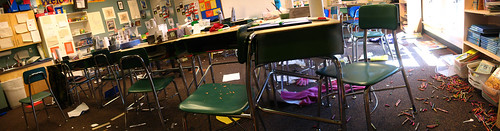
(Photo - "Panorama of an Extremely Messy Classroom" - Jenicra84)

Wednesday, March 19, 2008

Where Were You When - Obama's "A More Perfect Union"

Like most people I can recall several events from my life and remember exactly where I was, what I was doing, and that these events had a profound effect on me. Two of these events were speeches by John F. Kennedy - his "Ask Not" speech and his "Ich Bin Ein Berliner" speech (I will also never forget where I was the day he was assassinated either, even though I was only 7 years old.

Well I now have a third speech that I will remember - Barack Obama's "A More Perfect Union". Take the time to listen to what he has to say - it is most profound...

Sunday, March 16, 2008

Notes From The Brier - Final Thoughts

I'm back home and back to work tomorrow. Had a great time sharing the Winnipeg Brier with Dad - curling fans are amazing people - I have never had so many conversations with strangers in all my life - about curling, the weather, politics, you name it - and all friendly and engaging as if we had known each other for years - as I've already said - there was a real sense of community in the MTS Centre - even in the lines for Tim Hortons (which had to have set some sort of Guinness record for most patient people in one spot).

I will take away a lot of good memories, of spending a great two weeks with Dad, of meeting some great people, seeing some great curling, and all in all getting relaxed and refreshed, ready to go back to work.

My only regret is that I brought the snow back with me from Ottawa. Sorry about that, but they have more than enough to go around - check out the picture with this post.

So good luck to the Brier finalists who meet each other later tonight - Alberta and Ontario (the defending Canadian and World Champion) - it'll be an amazing final, you should watch...

Thursday, March 13, 2008

Notes From The Brier - Of Haves And Have-Nots

One of the things that I have noticed at the Winnipeg Brier this week (other than the incredibly long lines at Tim Hortons) is that despite there being 12 teams at the Brier (one from each province, Northern Ontario (a men's curling quirk - the women's championship invites back Team Canada, the defending champions), and the Yukon/Northwest Territories), there is in reality only 3 or 4 with even a reasonable shot at actually winning the title. Curling, like most sports is extremely expensive and time-consuming if you want to be the best, and this year the best include teams from Alberta, Ontario, Saskatchewan, Manitoba, British Columbia, and Newfoundland & Labrador. Of these, the champion will probably be one of either Alberta or Ontario - and both of these rinks are effectively professional curlers who have dedicated the time, money and effort to become the best in the world.

With the top teams, curling becomes a game of inches - with the others a game of feet - there is no comparison. If curling is to maintain itself as a sport, it must find a way to level the playing field so that everyone who gets to the Brier has an opportunity to be successful, or after a while the have-nots will get tired of being cannon-fodder and the Brier will suffer...

Notes From The Brier - Of Men and Brooms, and Communities...

Lots to see at the Tim Hortons Brier here in Winnipeg - amazing curling, amazing people and crowds, and men with brooms. It took a sport like curling to even introduce men to brooms, because I don't know about you, but I for one applaud the rights of dust bunnies in their quest to become sentient beings. For all of those housework-challenged males out there (and you know who you are...) you may want to take up curling and ease into that whole wielding a broom at home thing...

The real cool thing at the Brier though is the sense of community or should I say communities - each province and territory has a team - there are communities supporting each of them, there are the pin traders, the curling fanatics, the curling novices, organizations like the Governor General's Curling Club, local clubs and associations, and many, many more - some who have been around for 50 years and longer. Then there is the organizing committee, and the hundreds of volunteers that make the whole show work. A whole series of individual communities that collectively comes together to be the Brier.

I have spent a week listening to perfect strangers talk to each other like life-long friends joined by the sense of community of their sport and the event. There are people who make the annual trek to the Brier - their annual community get together and many have been doing this for scores of years.

Being surrounded by all of this sense of community has gotten me thinking - if we are so good at making and being part of communities in our day to day lives, how can we successfully bring this into learning communities - which for me will be (and are) the future of education - learning has become too complex and there is just too much information out there for learning not to be done collaboratively in a community - the key is how do we do that? we need to take our ability to form and nurture communities and do the same for our faculty, staff, learners, and institutions of learning - learning is a team sport - it works best in a community that will encourage and foster it - I have lots to say about that - stay tuned...

But for now it's back to the Brier - "HURRY HARD!!"

Monday, March 10, 2008

Notes From The Brier - Coffee and Curling - I AM Canadian...

One of the joys of living in a culturally mosaic country like Canada is that you are exposed to so many different traditions, events, sights, senses, and sounds that you can lead a very rich life. The downside of living in this culture is when someone asks "what's Canadian?" it's sometimes hard to figure that out - at least until now...

I'm in Winnipeg (or as it is also affectionately know, Winterpeg - when we arrived last week it was -44 C with the wind chill - but it's a "dry cold". Yep - it sure is...cold) with my father attending the Brier - the men's national curling championships - officially know as the Tim Hortons Brier. There are probably no two things more quintessentially Canadian than curling and coffee, particularly in the winter and particularly Tim Hortons coffee. True, coffee did not originate in Canada, nor did curling (like many things it was invented by the Scots which just goes to show you what perpetual bad weather can do for creativity), but we were smart enough to combine the two and turn them into a cultural event of epic proportions.

The line ups this week at the MTS Centre have been longer for the Tim Hortons orders than for the box office and attendance has been great - and it's great for the event - a highly caffeinated audience watching some of the best curling in the world - it's a win win! I've heard as many requests for a "double-double" this week as I've heard "hurry hard" coming from the competitors.

We're having a great time here this week, so the next time someone asks you "what's Canadian?", tell them to get a large double-double at Tim's and head for the local curling club - the essence of Canada. Hmmm...

Monday, March 03, 2008

Obama and Clinton - "We" and "I"...

First off let me say that Henry Jenkins is amazing and a must read for all educators. His recent post "Obama and the "We" Generation" has really gotten me thinking about and looking at US politics, not that there is much choice what with all of the 24-hour multi-channel coverage and all.

He starts by noticing that adult leaders were using "I" and "what I can do for you" a lot to describe what they did while younger leaders used "we" and "what are our goals...". Obama is the "We" and Clinton is the "I". As Henry Jenkins puts it - Obama is more of a movement than a campaign. He talks of community and organizes bottom up instead of the traditional top-down campaign model. Hillary Clinton is running very much an "what can I do for you" traditional campaign and now that I am aware of this have I ever noticed a difference,

An article in today's New York Times really brings this difference in the two approaches of the Democratic candidates home - "In Texas, Clinton’s Veterans Test Obama’s Rookies". The article describes the difference between the two campaigns as they set up in Texarkana - the Clinton campaign set up in a big building and handed out phone numbers to campaign workers to start calling. Down the street in a small office, two Obama supporters without any official campaign sanction set up their computers and self-generated activity to get the word out on their candidate.

This describes exactly what Jenkins is saying - Clinton is the controlling "I" candidate and Obama is the open, bottom-up "We" candidate - He is a movement, not a campaign,

My very good friend Randommind described to me an even better analogy from Henry Jenkins (and must blog about it :-)) that brings this diagrammatic difference between the two candidates home - Obama is a Wikipedia stub, and Clinton is the Encyclopedia Britannica - such an amazing analogy I had an AHA! moment when I first heard it. It so accurately describes the fundamental differences between the two campaigns - and for me explains why Obama has been so successful - he is letting the voters participate in the campaign to become a part of his "movement", to build the Wikipedia entry, while Clinton is simply telling everyone that she knows what is best and is ready to do the job Day One - the bound and printed Britannica entry.

There are implications here for educators - we can learn a lot from the differences in these two campaigns. Obama's success to me shows that engagement and participation, the creation of community is something that people understand and want - this leads directly to the creation of learning communities. Clinton is the old "sage on the stage" telling us what we want to hear. Obama is creating a "learning community" (a political community?) where participants engage in the election process - they feel a connection and a sense of belonging, of being part of what Henry Jenkins calls a movement. If this works for a presidential candidate (and it sure seems that it is), then it should work in our classrooms too, don't you think?

I wonder who will win...?

(Photo from "The State Of...")

Multi-Generational Learning And Development of Learning Communities...

One of the issues addressing adult educators is how to develop educational opportunities for learners from multiple generations and create learning communities that support the success of learners regardless of what generation they belong to. This is particularly true when looking at e-learning and other non face-to-face learning opportunities as we are less likely to identify the generations of our learners based on their appearance. It also adds the complexity of dealing with digital natives and digital immigrants.

The Aetna insurance company has done some interesting stuff in this area. They identified the following groups to whom they were providing training:
  • Silent Generation, ages 62-77
  • Baby Boomers, ages 52-61
  • Late Baby Boomers, ages 43-51
  • Generation X, ages 31-42
  • Generation Y, ages 18-30
Aetna found each of these groups had unique cultural and learning preferences that came from their individual experiences acquired during their formative learning periods. Aetna began developing training more closely aligned to the learning styles of each group.

Here are some of the more interesting things that Aetna discovered while developing their age-group specific training (taken from the article):
  • Baby Boomers and Late Baby Boomers like linear courses in which information is covered in a very logical, progressive manner. They struggle with simulations. They also accept objectives. If you tell them upfront what the course objectives are and what the training will cover, they are apt to accept what you say.
  • Generation X learners appreciate new technology and expect a certain amount of interactivity. Like Boomers, they prefer linear content, but they also want to be able to "test out" of courses when they reach a point where their level of knowledge is sufficient. Those in this generation also want choices, such as being able to turn audio and closed-captioned text in a course on or off. They want you to teach them what they need to know and apply all the time. If there is something that they won’t likely apply for another six months, they prefer not to receive training on it. They'd rather receive a performance support tool or job aid to which they can refer later.
  • Those in Generation Y like to freeform it. The first thing they like to do in a course is take a test and figure out what they don't know. Then, they want to be able to go back in and learn what they don't. They also want to navigate through parts of a presentation in the order they prefer. Then, they want to have the option of researching references at their discretion.
This information has implications for us as adult educators - we have to get to know our learners, particularly in a blended or distance learning opportunity in order to develop educational resources that will assist learners regardless of their generation.

Here is what Aetna did:
  • For Generations X and Y, more of their e-learning now incorporates games and simulations. Content search and research capabilities were also added to a number of courses.
  • To meet Generation X's preference for learning takeaways, Aetna began building more performance support tools for those tasks that learners don't perform often. Because this group likes choice, Aetna also added an audio on/off and closed-captioning option to many of their courses.
  • For Generation X and Y learners, Aetna changed the way in which they write course objectives. If you put objectives at the beginning of an e-learning program, Baby Boomers will read and accept them. Generation Xers and Yers won't. So Aetna began telling a story instead. The story usually explains why the training is necessary (e.g., Here's a situation and here is the outcome that will occur if the situation is not handled properly.)
  • For Generation Y learners, Aetna adopted The Thiagi Group's Four-Door approach to e-learning, in which learners choose their best learning style and can shift from one to another to meet their needs. This approach, which consists of the Library (performance support and reference materials for self-study), the Playground (learning through gaming), the Café (learning through social interaction) and the Torture Chamber (the opportunity to test one's skills or knowledge through simulation) is having a tremendous impact on our Generation Y learners. (Taken from the article)
There is much to be gleaned from Aetna's experiences and applied to adult learning opportunities and the development of multi-generational learning communities, particularly as we move towards more and more mobile learning...

Another really good post on this subject is Natalie Laderas-Kilkenny's blog "Design For Learning"and her post on Generational Learning Styles and Methods. The continuum that she includes in her post clearly identifies various learning generations and what learning styles and methods work with each of them...

Friday, February 22, 2008

It's All About Context...

I received some great comments on posting Stephen Downes's Reality video. In those comments, context was mentioned as being key to learning.

Well, turns out that context is key - it can even lead us to see and believe things that are nt there. A study at University College London has seen this. here is a quote from a report on the study:

"Scientists at UCL (University College London) have found the link between what we expect to see, and what our brain tells us we actually saw. The study reveals that the context surrounding what we see is all important -- sometimes overriding the evidence gathered by our eyes and even causing us to imagine things which aren't really there."

Neat stuff. One of the very interesting things that came out of the study is that a vague background context was more influential than a clear well-defined context - explains why different people see different things - a critical thing to remember when dealing with learners.

It also explains how illusions work, so if you are one of those people who believe in the magic, you may not want to read the study.

So there you have it - context is key - no context, no learning. Context explains why some people "get it" and some don't. Or does it? Depends on your context I guess. Hmmm...

Thursday, February 21, 2008

Reality...

Stephen Downes is one of the leading lights of online education and learning. His blog, Half an Hour is a must read for anyone interested in education, learning and technology. He is always thought provoking and interesting.

This video "Reality" asks several questions about what is reality and what effect does reality have on learning and students. It's an interesting watch:


Learning is about creating reality. Stephen also defines what learning is not - it's not remembering, it's not content - it's about creating patterns in the mind - growing meaning - fascinating stuff that really makes you go Hmmm...

Monday, February 18, 2008

Subscription Learning - Sign Me Up!...

Like most institutions, the college I work at delivers its learning in the form of boxes - classes, courses, and programmes. Classes are regularly scheduled, course are offered by semester and programmes are anywhere from one to three tears in length. All are delivered on a regular schedule defined by the academic calendar. Learners fit their learning into this schedule.

But what if there were a different way to provide learning? One that is focussed on the convenience of learners, not the rules of institutions - what if a course had no actual end date, or start date, and it could be changed as needed while being offered and could accommodate different learning styles, then perhaps such a course could be "sold" by subscription. Learners would sign in and out of the course when they wanted to over the life of the subscription on a schedule that works for them fit. No different than how we read magazines, or watch cable channels or get RSS feeds - we subscribe to them and use them on our own time, at our convenience, not the convenience of the providers.

The design of a course delivered by subscription would have to be fully interactive and activity driven... a key would the evaluation of the activities and the artefacts they produce, for example, that can evaluate learner progress. A competency-based assessment system that allowed learners multiple opportunities to become successful and was both formative and summative would work best. A portfolio learning approach would also be a key element of subscription courses, giving the learner and the facilitators a clear picture of the capabilities of the learner.

This subscription model, which would give a learner a mostly indeterminate amount of time to complete a course would work very well in an online learning environment. It would allow people to learn at their own rate and in their own way... with support from other students and expert facilitators.

A subscription based course model would also require a curriculum that is not based on
weekly class schedules, fixed assignment times, and semesters. It would require an adjustment in thinking in that a facilitator could be assigned to a course with learners in many varying stages of completion, something we do not do a lot of yet. But it is a great way to model education without boundaries, learner and learning-centred education. Subscription based courses would also allow an institution to provide learning opportunities where formal outcomes may not be as important as skill development and community access. The community of community college. This model would work for both credit and non-credit courses.

So would subscription learning take over the current system of schedules, courses and semesters? Maybe not, but it would certainly provide one more learning-centred opportunity and truly be education without boundaries. I think it is something that needs further exploration...

(Photo - Cargo by Miskan)

The Canadian Health Care System Saved My Life...

As Canadians it's our God given right to complain - we complain about the weather, about taxes, about our government or a lack thereof, and particularly about our health care system - too slow, too hard to be seen by a doctor, you name it, we complain about it. depending on who you talk to we either have the best or worst health care system in the world. heck, with this being an election year in the USA, our health care system is getting knocked down there too.

Well, I will never complain about our health care system again, because last week it saved my life. I developed pneumonia nad had exhausted myself trying to breathe - I was later told I was only hours away from REALLY bad trouble. I went to Emergency where you hear of the multi-hour wait, but they triage patients and I was taken in right away. I was quickly assessed and treated and all of the doctors and nurses were absolutely amazing - I received amazing care. It was determined that I needed to be put on a ventilator to give my body rest and I spent two days in ICU, and seven days in hospital all together. I am now at home recovering nicely (I think).

During my whole stay in hospital I was treated incredibly well by the doctors, nurses, therapists, everyone was positive, caring, and obviously loved what they were doing. their compassion and empathy went a long way to helping me heal.

I just want to take this opportunity to thank each and everyone of them - Dr Petrie, Dr. Greene, and all of the Emergency nurses and staff, Dr. Gallager (a wee Scots gentleman - my Mother would have loved him), and all of the staff of the ICU, and all of the nursing staff and doctors (specially Turkie - thank you so much for your caring and gentle manner)on the 8th floor - you are all my angels and life savers - thank you so much.

So this is one Canadian who has one less thing to complain about - we have a health care system that works and is there when it is needed - for that I will be eternally grateful...

Sunday, January 27, 2008

Let's Not Just Do Things The Way We're Used To Because That's All We Know...

There is a group of us who gather regularly in Second Life (come join us in Bam) to talk about a lot of things, but most things of an educational nature. lately we have been talking a lot about learning communities, tools for reaching learners, and what's important to us as adult educators as we and our learners move forward.

In one of these recent conversations one of my colleagues made the following statement:

"let's not just do things the way we're used to because that's all we know"

As educators we are a the cusp of a whole new paradigm of learning - the classrooms that have been around since the time of Victorian England (Dickens and Nietzsche would not feel out of place in our classrooms - can tat be said of just about any other part of our modern society?) and before are becoming the least popular way for our learners to learn - they are looking for convenience, mobility, and flexibility. For many learning is just another product or commodity to be purchased and consumed where and when they want to, not where a brick institution or an old lecturer tells them too.

We have to meet our learners where they are - so keeping this quote in mind we have to know what it is they are using to get their information, when they want to learn, and how they want to learn - knowing these things is critical for the future of post-secondary education.

Will the classroom ever go away completely - probably not, but the regularly scheduled class in a brick classroom may - replaced by mobile learning that can happen anywhere and the PLE that meets the learners needs. We will need to be better at engaging our learners and giving them a larger voice in what exactly their learning looks like. There will have to be options - where you learn, how you learn, when you learn.

So keep in mind my friend's quote - "let's not just do things the way we're used to because that's all we know" - let's do things because they are best for learning and best for our learners. Hold on, it's going to be a bumpy ride...

Monday, January 07, 2008

Eight Things You Don't Know About Me...

My friend randommind sent me this post - "8 Things You Probably Didn't Know About Me". It's part of an internet meme making the rounds of the blogosphere. The idea is that you list eight things that people didn't know about you then "tag" eight other people. Sort of an internet chain letter. Well. I'm going to play along, sort of, and list eight things that most don't know about me. I'm not going to tag eight others as it seems that my friends have already been taggedin this process.

So here goes - eight things that you didn't know about me:
  1. I was awarded the RMC Club of Canada scholarship in 1974 to attend the Royal Military College of Canada - I turned it down because that summer I did basic officer training at CFB Shilo and I didn't want to end up like my platoon commander, a recent RMC graduate. I went on to serve 28 years in the Canadian Army Reserve, retiring as a Lieutenant-Colonel in 2001
  2. I've always wanted to jump out of an airplane (with a parachute) but have never had the courage to do it - mind over matter and right now mind is still winning and keeping my feet firmly on the ground
  3. I'm allergic to cats but love (I love dogs more but live in an apartment building that is not dog friendly) them and an still thinking of getting a Maine Coon cat
  4. I'm not afraid of heights but I get the willies if I look up from a high place (what's that all about?). I have no problem looking down from a great height (of course I'm 6'6", so that might have something to do with it)
  5. I love military history, particularly World War II - the strategy, tactics and politics of the era
  6. I have never gotten lost, temporarily misplaced, but never lost. When I travel to a strange place I love getting a map and just exploring - it's the best way to see the sights.
  7. I spent the equivalent of grades 2-4 at a British school operated by the British Embassy in Bonn, West Germany (Dad was posted to the Canadian Embassy) and the PNEU. I learned things in those three years (math, biology, geography, economics...)that I didn't see again until I was in high school in Canada and I sailed through school because of what I learned and the study habits and skills I developed as a 7-9 year old - what's that all about, and what does it say about our education system?
  8. Like many educators, I am an introvert - do not put me in a social situation with a room full of strangers - I hate it. Put me in a classroom with a room full of strangers who are there to learn and I love it...
So there you have it - eight things you didn't know (but might have suspected) about me...

(Picture - "8 Mosaic" - by Leo Reynolds)

Sunday, January 06, 2008

Personal Living Networks... AHA!!!

One of the best education blogs out there is Will Richardson's Weblogg-ed. It's one of my regular stops in the blogosphere and should be one of yours too.

In a recent post he talks about "Personal Living Networks", and I had an AHA! moment. He quotes Chris Lott:

“In the emerging model, students learn to navigate, assess, construct and participate in a living network that comprises the heart of their learning network and they take that with them when their time as part of any particular institution’s offerings come to a change…’Going to school’ is an activity that has a life and dies; learning is a continuing process. Enrollments and degree programs terminate; personal living networks accompany learners through life– the ultimate educational institution– serving as companion, confidante, and oracle alike.” Chris Lott

Chris Lott is another must read for educators, and he in fact uses the term "personal living environment", feeling that limiting it personal learning environment is too narrow a focus.

Anyone who has read my blog know that I personally believe that PLEs (Personal Learning Environments) are the future of education - they will get us out of our neat rows of desks in classrooms, away from one-way lectures, and allow us to deliver education when, where, how, and why, learners want it. They will place more responsibility on learners to become engaged in their learning, to collaborate with each other and their facilitators, to use mobile devices to get learning when and where they are at and to participate in an open educational environment. In other words what I have coined as ECMO - Engagement, Collaboration, Mobility, and Openness.

What Will Richardson and Chris Lott are saying makes so much sense - it is more than just personal learning - it has to be personal living, that education is a life-long process that they have to manage along with the rest of their life.

I love what Chris Lott says:

"“Going to school” is an activity that has a life and dies; learning is a continuing process. Enrollments and degree programs terminate; personal living networks accompany learners through life– the ultimate educational institution– serving as companion, confidante, and oracle alike."

This is what we as educators have to instill in our learners - if we do nothing else, we must do this...


(Photo - "Collaborative Technology Labs"- by MSU Libraries)

Saturday, January 05, 2008

I Just Like The Picture...

No particular reason to post this, I just like the picture - lots of noise if you look closely, but the tree at dawn just looks mysterious and brooding somehow. I took this last Thursday out the front of my building on my way to work:

Monday, December 31, 2007

Looking Back, Looking Forward...

Happy New Year everyone! Hard to believe that another year is past and a new one about to begin. Thought I would take some time to look back at 2007 and look forward to 2008 (everyone is doing it - so figured I might as well too!).

I posted over 150 times in 2007 - my God I'm wordy! Hopefully I had some things to say that actually made sense. Many of my posts happened at conferences I attended (STLHE 2007 and CIT 2007) - I found that blogging the conference experience "live" was a great way to fully experience what was happening - great way to reflect on the day's events and get ready for the next day.

I also spent a lot of time focussing on education and in particular what I see as the future of education - the Personal Learning Environment (PLE). PLEs, and the increased use of mobile devices will have a major impact on how we design and deliver learning over the next few years. Learners will want more specific and customized learning that will fit into their increasingly busy lives - more flexibility, more options. Institutions will leverage distance and blended learning to increase enrollments with limited investments in capital building projects (and online courses cost a lot less than having to build additional brick learning spaces).

So here is what I think will be the "big things" of 2008:
  1. Blended learning and blended learning opportunities will increase - in the end (maybe not the end of 2008 but soon after), more learners will be taking a blended approach to learning than a traditional classroom only model
  2. Second Life will continue to grow and will be bought by one of the big players in the Internet (Google, Yahoo, Microsoft...)
  3. Open Source will continue to take away from proprietary software - Google Docs and similar online collaborative "suites" will increase in use and popularity
  4. Web 2.0 apps will become mainstream as businesses and educational institutions start to use them regularly
  5. E-Mails use will decline in favour of IM, Twitter, Facebook and other more immediate forms of communication - EMail will be for "communicating with old folks"
  6. Facebook will still be big, but may decline as people become tired of all of the "applications" cluttering up the interface. Look to Orkut and other social networking sites to grow among those wanting to be social without all of the "other stuff". Ning will grow in the creation and use of personal and customized social networking sites
  7. I hope that someone creates the social networking equivalent of Meebo allowing me to use one interface for all of the social networking sites that I belong to - Facebook, LinkedIn, Bebo, Ning...
  8. Microsoft Windows Vista will continue to struggle, good news for Apple and Linux distros like Ubuntu. More and more educational institutions will look at multi-boot Apple computers as the solution to their IT infrastructure needs.
  9. The iPhone will come to Canada - PLEASE!!!! The iPhone is the future of learning...
  10. I'll continue to blog in 2008, focussing on education and other things that make me go hmmm... including my new mantra of ECMO - Engagement, Collaboration, Mobility, and Openness - it's where education has to go...
To provide some balance, here are some other views of the year past and the year to come:
So there you have it - a quick look back and a quick look forward. All I can say is that I'll continue to post here and hopefully some of it will even make sense.

Happy New Year everyone!


Gotta love iStockphoto - this same image is on the front page of today's Ottawa Citizen!

(Photo - Janus Coin by Marco Prins)

Thursday, December 27, 2007

Strengths Finder - So That's Who I Am!!...

At NSCC we are in the process of revamping our performance review processes. We are taking a positive spin on performance management and one way to do that is to identify strengths, not weaknesses. In order to do this this we are using Strengths Finder 2.0 from the Gallup organization.

Strengths Finder 2.0 is a set of 177 paired statements for which you have 20 seconds per pair to select on a Likert-like scale the one that most resembles who you think you are. After completing the questions, your answers are analyzed and the results are returned listing your top five strengths from a list of 34 themes.

The work behind the Strengths Finder approach was done by Dr. Donald O. Clifton. Here is a brief biography of Dr. Clifton from the Clifton Strengths Prize:

"Over a 50 year career, Dr. Donald O. Clifton established a movement in psychology that focuses on talents and strengths. This work earned Dr. Clifton recognition as the Father of Strengths-Based Psychology in an American Psychological Association Presidential Commendation. Dr. Clifton’s core philosophy was to have people focus on what was positive and right with themselves, and to build on their strengths to achieve their full potential."

I first took version 1.0 of the Strengths Finder (known as Strengths Quest) shortly after beginning my job as academic chair. Here are my top five strengths from that test:
  1. Learner
  2. Intellection
  3. Achiever
  4. Developer
  5. Arranger
The big surprise to me after taking this first version was how closely it was to whom I thought I was (each strength is described in details in supporting reports). Over the years I have done Myers-Briggs, DiSC, and others and always had some disagreement with the results. I did not have those same disagreements with Strength Quest.

I also asked several of my friends and colleagues what they thought of my results and almost unanimously they said that it was me - we had consensus :-).

As the College continues to roll out our new performance system, many of us will be taking workshop training in this new strengths-based approach. In preparation for this workshop, I took the StrengthsFinder 2.0 battery this past week, almost six months into my position as academic chair. Here are my top five strengths:
  1. Learner
  2. Intellection
  3. Input
  4. Achiever
  5. Responsibility
As you can see, three of five of my strengths have remained the same (Learner, Intellection, and Achiever), while two have changed - Input and Responsibility, which replaced Developer and Arranger. Input is about collecting and storing things, responsibility is about committing to what you do, achiever is about is about drive and arranger is about organizing and getting things done (these are all very brief paraphrased descriptions - to get the details buy the Strengths Finder 2.0 book). Now, all of these strengths describe me and I believe that I possess them all - they help me do the job that I do.

The question for me is why the changes from the first test? Were these my sixth and seventh strengths and I simply re-ordered them, or has six months as an academic chair given me a different "perspective" on my strengths and impacted their order. Hopefully this will become clearer as I go through the workshop and we adopt our new strengths-based positive attribute performance management system. What do you think? Hmmm...

It's So Simple!...

Just finished reading John Maeda's "The Laws of Simplicity". It should be required reading for all educators, in fact for all learners. A very small book (deliberately limited to 100 pages), it lays out 10 laws and three keys to simplicity (one of which is that simplicity cannot exist without complexity - how else would you be able to recognize simplicity?).

For me the key point of the book is Law 10 - The One - Simplicity is about subtracting the obvious and adding the meaningful - to me, as an educator, this describes learning in a nutshell. It also supports my position that the future of learning is in the hands of learners and their development of personalized learning environments - the PLEs that I keep going on about.

The Laws of Simplicity are very much an evolving concept and there is a lot of great material at the lawsofsimplicty.com Web site. of particular interest to me are all of the resources John Maeda has added to the site along with his posts on some of the most fascinating designs out there today.

John Maeda has recently been named the next president of the Rhode Island School of Design (RISD). Here is probably the most unique presidential acceptance I have ever seen - but it so fits. I can only imagine what great hings are going to happen at RISD with John Maeda's leadership and vision.

I can't encourage you enough to read this book. Now if only I can bring some simplicity to my own life...

Monday, December 24, 2007

Happy Holidays and Season's Greetings

Happy Holidays and Season's Greetings to everyone. If you have read and or commented on my blog in the past year, thanks very much.

Here's wishing you a safe and wonderful Holiday season full of family, friends, and good cheer whatever holiday you celebrate.

All the best in 2008 and I'll continue to muse about those things that make me and hopefully you go hmmm...

Thursday, December 20, 2007

Convergence Culture and Education...

I've just finished reading Henry Jenkins's book "Convergence Culture", and let me just say that if you have not yet read it that you should. His blog "Confessions of an Aca-Fan" should also be required reading for anyone interested in modern media, culture and their impact on what we do day to day. Essential reading for educators.

The book is full of useful information and insights, and I had several "AHA!" moments while reading it. The central theme of the book is that we are in a new media era where it is the consumer that is dictating the content, style and presentation of media and its content, not the traditional "old media" of large companies and defined media steams (radio, TV, newspapers, etc.) dictating when, where, what, and how we receive our content. Henry Jenkins presents a clear picture of the way our learners look at media as a tool that they can and should control, with them dictating the when, where, what, and how of content. Here are some of the highlights of the book for me (all attribution for excerpts from the book to Henry Jenkins):
  1. The distinction between mass culture and popular culture - mass culture is a category of production while popular culture is a category of consumption. Popular culture happens when the materials of mass culture get into the hands of consumers - Henry's example is a song becoming an "our song" for example. I like this definition and in my mind there is a definite shift towards popular culture as consumers take things on board for themselves and have much more creative freedom because of the Web and the tools now available to create and consume culture.
  2. How the smart media companies seized on convergence culture and became successful because of it and the best example is probably the "Star Wars" juggernaut. Part of the massive appeal of Star Wars and the mythology that has grown up around it has to do with how George Lucas has allowed consumers to craft their own visions of the legend and to expand upon the legend through the creation of their own movies and stories. the book also cites examples of old media organizations who didn't quite get it right by zealously "protecting" their brand and copyrights (we know who you are, don't we?)
  3. How convergence culture, and in particular blogging had an impact on the 2004 US presidential campaign. Blogging changed the dynamic of traditional news and public opinion (anyone could now be a political commentator), and changes to campaign funding rules shifted control of the campaigns from the candidates to independent action groups (remember "Swift Boat Veterans for Truth"?). The political scene in the US (and I suspect everywhere in the developed world at least) has been forever changed by the shift to consumer engagement in the use of the media.
  4. The biggest "AHA" moment for me was when Henry Jenkins stated that one of his book's central arguments is that the biggest change occurring with media is the shift from individualized and personalized media consumption towards consumption as a networked practice. Boy is this so true! Just listen to a group of learners discussing what they have watched or read, or how the are telling each other about what they found on the Web last night - it's one of the most powerful learning tools we have today - collaborative learning.
  5. One of the final thoughts n the book is about education - historically public education in the US (and the same can be said for the education system in Canada) was meant to distribute the skills and knowledge necessary to train informed citizens. This doesn't work anymore - we have a participation gap and citizens today need to be more than informed, they need to be monitorial - not just being able to read and write but being able to participate in the deliberation over what issues matter, what knowledge counts, and what ways of knowing command authority and respect. The ideal of the informed citizen is in trouble because there is simply too much to know. The ideal of monitorial citizenship depends on developing new collaboration skills and a new ethic of knowledge sharing that will allow people to deliberate together. (page 259). This describes for me exactly the issues I am seeing in the classroom with learners - they need these "new literacy" skills of collaboration and information sharing in order to manage the sheer volume of information available today.
  6. The problem is that people for the most part are learning these new skills outside of any formal educational institution - they are developing their skills through affinity sites, newsgroups, social networking sites and other new media opportunities - Henry Jenkins actually points out that many schools are openly hostile to these developing skills and go out of their way to stop their development (anyone blocked Facebook recently?). This HAS to stop - it does a disservice to learners - we need to foster and develop these collaborative skills - they are essential to the future of our learners and our educational process.
As you can see Convergence Culture has had an effect on me that I think will improve what I do as an educator - I cannot recommend too highly it or anything else that Henry Jenkins does - if you have an opportunity to read what he writes or listen to what he says, take it...

Sunday, December 16, 2007

The Incredible Shrinking Man - Me!!

I weighed in the other day at a svelte 333 pounds. Now that I have your attention (and mine!), this is my public announcement that I plan on doing what it takes to lose weight - and I will be periodically posting on my progress as a way to motivate myself (besides the obvious health benefits).

I don't really have a target weight, but I do want to feel better in my clothes and to feel fitter overall, so I will mostly be eating better and exercising more - there is no easy way to do this.

For me this adventure will bring some fundamental lifestyle changes which I hope I can stick to. We'll have to wait and see. Stay tuned...

P.S. This is my "before" picture:

Engagement, Collaboration, Mobility, and Openness - The Future of Adult Education

There is an awful lot of talk and research being done in adult education - how to get learners to come to post-secondary education, how to get them to stay, how to best deliver education to them, and what are the best ways to ensure that learners are receiving the education that they have signed on for and that we as adult educators want them to have. What will we have to do in the future to address these concerns?

After listening to and reading about all of this adult education material I have come to the conclusion that there are four issues that we need to address. They are:
  1. Engagement
  2. Collaboration
  3. Mobility
  4. Openness
Engagement is getting learners to come to your institution, select a programme, actively involve themselves in it, and actively contribute to their learning. This may be the hardest part to do - being engaged is a personal, internalized activity and as educators we cannot force engagement - we must foster it in our learners. So how do we do that? It starts with allowing learners to make informed decisions as part of the Admissions process, and then keeping them involved in their learning once they are in a programme. In the Admissions process learners must be given the opportunity to learn exactly what their programmes are about and what the standards and expectations of the institution and faculty are. Tests drives or visits to the programme are a big part of this, along with good information materials.

Once in a programme, it is my opinion that the best way to engage learners is to actively involve them in their own learning process - and I believe that the best way to do that is the personal learning environment or PLE - get learners involved in deciding for themselves what works best for their particular learning style. maximize the use of of recognition of prior learning (RPL), and develop outcomes-based learning, and competency-based assessment models that allow for maximum flexibility.

Collaboration ties nicely into engagement - in a collaborative learning space, engagement is key for success and collaboration fosters engagement as learners develop relationships with each other. Collaboration is now, and will continue to be in the future, key to learning. There is simply too much information, too many sources, and it's all coming too fast for learners (and educators) to learn on their own anymore. Collaboration, and the development of information literacy skills used collaboratively for the sharing and assimilation of information are essential for learning. Collaboration also occurs when using project-based learning, something I have done with great success (information technology education) prparing learners for industry. Almost without exceptions employers demand graduates who are capable of working collaboratively and who are capable of learning (engaged in their profession).

There are two aspects to Mobility. Mobility is the lifestyle of a lot of our learners - IM, chat, text messaging using mobile devices is how they communicate. E-Mail is something they use to talk to old folks. Secondly, mobility is how we will have to meet learners where they are and how we will continue to grow our institutions. We need to develop materials and resources that can be used on mobile devices and online and in blended deliveries. As faculty and staff we must become expert at delivering engaging, collaborative learning opportunities to learners wherever they are using whatever tools and devices they have for access. We need to know what those tools and devices are and how to use them and how to develop resources for them. There is a huge professional development component here.

Institutionally we must all do more in the distance or mobile space - we cannot afford to increase physical infrastructure to increase enrollments and I'm not all that sure that physical spaces best fit the lifestyles of community college learners anyway - they are mobile, they live at distance in many case, they work and have families and the traditional Monday to Friday daytime only learning model is not working for many of them. If we want to capture these learners we must become mobile and meet them where they are - think way out of the box.

Openness means several things to me - it means limiting or eliminating barriers to learning - we can do that through the development of PLEs and readily accessible learning opportunities. It means faculty sharing with each other and their learners, maximizing the user of Creative Commons licenses when intellectual property is an issue, using and contributing to sites like the OER Commons, and engaging learners in their learning process. It means limiting barriers caused by the use of proprietary software and hardware and maximizing the use of open source and shareware/freeware that is operating system independent, allowing learners access to learning regardless of the technology they are using (while remembering that technology is only a tool). It's engaging everyone, all stakeholders, in the curriculum development and learning development processes to ensure that we deliver learning that works. An open education environment will be an effective learning environment.

To me this all seems fairly obvious now, but it has taken me some time to get here. It will be interesting to see if any of this will actually be relevant as we move forward. I am firmly convinced that it will be, but time will tell...


(Photo - School Photo From Tungelsta by Steffe)

CIT 2007 - Some Final Thoughts

It's taken me a while to get to this point - my last post about CIT 2007. This has been partially due to returning to a busy job, and partially due to some obvious inertia on my part. But the single biggest reason why it has taken me this long to get there is that there was just so much to absorb and reflect upon.

CIT 2007 was an amazing experience on many levels. I met some very cool people who had some amazing things to share - and that was probably one of the coolest things about the conference - how willing people were to share and talk about what the were doing - there was a great collaborative spirit throughout.

I also learned a lot about myself , the community college "industry" in North America, and about my own institution as well. For myself I confirmed that I am well immersed in all things Web 2.0 and learner and learning-centred, more than I realized - several of the presentations were at the introductory level, discusing isues of implementation and engaging learners. This may explain why in some circles I may be considered "weird".I need to keep an eye on that one...

As for the state of the community college "industry" I found that most colleges have the same issues - retention, engagement and how to reach the current generation of learners. While there were no perfect answers at CIT 2007 for these problems, it was nice to know that we were not alone in going through them and that it appears to be a phenomenon right across North America. The other good thing is that many are trying to find solutions, and the solutions seem to hinge on the following - engagement, collaboration, mobility and openness (much more on these themes in later posts).

And the thrd piece is that here at NSCC we are doing some great things - portfolio learning, education without boundaries, access, service learning, project-based learning, and many other educational innovations. We need to be better and do more on the blended side of things - to move towards what Mark Milliron called "blurring blended" - a model where 15-20% or learners are entirely online, 15-20% are entirely in brick classrooms, and the remainder are blended learners taking a mixture of online and classroom courses. I truly believe that blended learning is the furure - it meets learners where they are - the engagement and mobility pieces, along with the openness. CIT 2007 also confirmed fo me that learning is now a collaborative function - there is simply too much information and too many sources for a learner to successfully navigate their education in anything but a collaborative environment.

So, all in all, CIT was a great opportunity and presented me with several confirmations and challenges. It confirmed that I am on the right track as an educator and challenged me to realize that the journey is just beginning that we as educators must continue to evolve and adapt to provide the learning environments and opportunities that will provide learners with the best possible chances for success. The next few years in adult education are going to be very exciting, and who knows - I may even become less weird,a s others catch on and catch up...

Monday, December 10, 2007

CIT 2007 - General Session - Dr. Randall Pinkett

My apologies for the delays in completing my posts from CIT 2007, but it's been a crazy few weeks here with end of semester wrap-up, meetings, and the general chaos of the fall semester at NSCC.

Now back to CIT 2007...

Dr. Randall Pinkett, Apprentice winner and founder of BCT Partners, a socially conscious consulting firm was the speaker. A very engaging and interesting figure, Dr. Pinkett spoke on the issues around connected colleges/connected communities - the role of community colleges in ensuring technological equality.

He spoke of guidelines for community technology:
  • Empower
  • Engage
  • Emphasize outcome, not access
And principles for community building:
  • Asset based
  • Internally focussed
  • Relationship driven
He described in detail a joint project with MIT at Camfield Estates in Camfield MA - the Creative Community Connections project. In this project housing project residents were provided with computers and training n their use. the results were that residents ended up with reinforced loyalties, heightened awareness, and much more social networking happened. a fantastic example of taking learning out into the community.

Overall the quality of life of the residents was enhanced, but to ensure success of these kinds of initiatives the community members must be engaged as active participants - and there are a lot of opportunities for these kinds of community engagements. The service learning opportunities would provide amazing learning for faculty, staff, and learners of any community college.

Dr. Pinkett is a very inspiring, driven person who has developed some great approaches to community development - BCT Partners are taking some innovative approaches to community development that as educators and community colleges we need to take a look at. For another perspective on Dr. Pinkett's presentation, check out this post from Randommind.

What an inspiring individual - Rhodes scholar, author, and dedicated to the improvement of communities - something we should all aspire too...

Sunday, November 25, 2007

CIT 2007 - Google Apps Education Edition

At CIT 2007 there were three themes that became clear to me - these themes were engagement, collaboration, and mobility. As educators we need to engage our learners across all of the generations - boomers, Gen Y, Gen X, millennials, and neo-millennials (a term used a lot at the conference - not sure if it's the same as millennials, or a new generation). To do that we have to go where they are at and technology will certainly help that. Secondly, modern learning has to be collaborative - there is just too much information and knowledge out there for one solitary learners to acquire, distill, and use. Collaborative knowledge is the future of learning, and finally we need to be mobile because our learners are mobile whether it be the devices they use, the places they live or how they consume learning (and they ARE consumers - for many learning and their education is just another product purchased for consumption).

One of the tools presented at CIT 2007 that helps meet the themes of engagement, collaboration, and mobility is Google Apps Education Edition. This online suite of tools includes the following Google tools:
  • GMail
  • Google Talk
  • Google calendar
  • Google Docs
  • Page Creator
  • Google Personalized Start (iGoogle)
  • Access to other tools like Google Spreadsheets, Google Presentations, Google Notebook, and Google groups, along with extensibility APIs
Google apps are user-centric, collaborative and available wherever there is a Web browser (engaging, collaborative, and mobile). Google Apps Education edition is free for students, faculty, staff, and alumni of an institution and can be customized with an institution's domain. It is ads-optional for students, faculty, and staff. It comes with integration support and 24x7 administrator support.

Central Piedmont Community College has switched to Google Apps. It has been available for use at CPCC since May 2007.

Personally I think that Google Apps Education Edition is the perfect solution for today's post-secondary learning environment - it meets the needs of learners, faculty,a nd staff - it's available whereverthey are - classrooms, labs, home, coffee shops, anywhere ther is a browser. But there are issues - and those are issues of data sharing and privacy. In order for Google Apps to work and to have access to Google's search algorithms and "secret sauce" (everyone at CIT 2007 had a secret sauce - what's yours?) some data needs to be stored on Google servers loacted in the US and not located at the institution (a particular problem for Canadian Institutions due to PIPEDA, our personal information privacy legislation). This could cause issues because Google will share information when:
  • With user consent
  • Imminent harm
  • 3rd Party processing
  • Satisfy applicable laws
  • Terms of Service
  • Fraud
If the issues of data storage and access can be satisfactorily addressed then I would strongly encourage all institutions to use Google Apps Education edition - it is a suite of tools for the future of learning that is available now...

CIT 2007 - Engaging Students In Online Learning Through Collaborative Activities

This was an amazing round table discussion led by Bret Nelson of San Jacinto College on transitioning from the classroom to online learning.

One the advantages of attending conferences like CIT 2007 ids that you get to travel with amazing colleagues who take much better notes than you do. So, instead of subjecting you to my ramblings, check out Randomminds's post "Tips For Teaching Online". She captured the session completely and there is nothing I could add.

I found Bret's enthusiasm and passion for teaching online quite contagious. the other very cool thing about this session was that there were two instructional designers from San Jacinto College participating and they had a lot of great input. It was apparent that they had a very close working relationship, and if I got one thing out of this session is that as online faculty keep your instructional designer close by - they are the real experts and will help you with that transition from the classroom to to cyberspace. Bret had all sorts if tips, hints, and tricks for developing and managing online learning.

The tips and hints that you will find at Randommind's post will hold you in great stead as you prepare (or are currently) to teach online - go read it now!...

CIT 2007 - Strategies For Working With Technology Resistant Faculty

This session was presented by John O'Brien, PhD AVP and CAO of Century College and Ron Anderson PhD CFO and VP Administration/Technology, also of Century College.

Century College is a 9,000 learner comprehensive community college located in White Bear Lake MN. the college has had a lot of change in recent years with 50% new faculty in the last five years and 50% growth in the 2000-2005 time frame. They have spent a lot of money on emerging technologies and have the challenge of ensuring that faculty and learners can use these technologies and are in fact comfortable with them. What about faculty who are hindered, skeptical, disgruntled, or left behind in the rush to new technologies?

The college conducted a survey of faculty to determine their comfort levels with technology. here are their assumptions before the study:
  • Enthusiastic - 20%
  • Interested/Hindered - 45%
  • Skeptical - 25%
  • Opposed- 10%
And here are the actual survey results:
  • Enthusiastic - 54%
  • Interested/Hindered - 34%
  • Skeptical - 11%
  • Opposed - 1%
It was apparent that from the survey results that faculty wanted to use technology in their courses and also that there needed t be supports in place to allow the enthusiastic and interested to flourish and to provide support to teh skeptical and opposed (who might always be opposed but who should not be excluded).

There are some best practice implications here:
  • Balanced offerings are ideal
  • Don't define technology too narrowly (for some it is PowerPoint) as online only
  • Recognize alternative technologies
  • Don't assume that technology is unquestionably good (this point really strikes home with me - even as an avowed geek, for me technology should always just be a tool, and the best technology is transparent to both learners and faculty)
In order to support faculty in using technology there has to be an openness to dissent. Some of the tools used at Century College include:
  • Teaching circles
  • Recognizing and celebrating non-technology innovations
  • Clarifying minimum "techspectations"
  • Acknowledge academic freedom
Effects of Technology on Teaching:

Best practice implications:
  • Positive experiences better than negative
  • Learning more important than enrollments
  • training focus - productivity and learning
Barriers:

A lack of technical knowledge and time to learn

Here is how we traditionally offer help to faculty when using new technologies:


There needs to be new support design elements:
  • Entry level training
  • Ongoing support and crisis support
  • Decide when to offer it
Disconnects:
  • Lack of visible institutional priorities
  • Perceived differences in perspective between faculty and administration
Motivating Incentives:
  • Main one was meerting learner expectations
  • Questions assumptions
  • Know the disconnects
  • Change the culture - serve left behind faculty
As a new college administrator (I am an academic chair responsible to three schools, a campus and with almost 30 full and part-time fculty that report to me) I found this presentation very useful. As a geek I found it even more useful - it began a seed in my mind that by the end of CIT 2007 had firmly plated itself - not everyone embraces and uses technology like I do (you tend to forget that at times) and there have to be mechanisms in place to ensure that everyone gets access and support when dealing with technology so they do not become overwhelmed and ultimately discouraged and disillusioned about technology in education

My own college is wrestling with several issues surrounding the use of technology in learning and this presentation will provide me with the balance I need as I work with others to ensure that we get the fit of technology and learning right...

Sunday, November 18, 2007

CIT 2007 - General Session - Dr. Chris Dede

Dr. Chris Dede of Harvard University presented on the changes to learning, thinking, and how we as educators have to adapt to the new learning environments.

Learners need to be empowered - collaborate to accomplish and learn. thinking is now distributed across space, time, and media.

Ubiquitous computing (wireless, mobile devices), along with smart objects and intelligent contexts have enabled augmented realities. Dr. Dede described the HARP (Handheld Augmented Reality Project) - a PDA with GPS that allowed a more engaged, immersive learning environment. the end state for this project would be the use of cell phones and modern wireless devices (again in my opinion the iPhone is the learning device/PLE of the future).

Learning now occurs in communities - these communities can even be distributed learning communities over great distances - what these communities have in common is mediated, situated immersion. There is a need to adopt a new pedagogy - we must teach the way learners learn. Augmented reality can be place independent or place dependent (Mystery@MIT is an example of a place dependent augmented reality).

Neomillennial learning styles:
  • Collective learning
  • Fluency in multiple media types (they are just tools)new forms of rhetoric
This has implications for professional development. Learners want to be part of it:
  • Co-design
  • Co-instruct
  • Situated learning
Communities of unlearning are developing and this will be a critical professional development issue as we try to figure out how to meet learners where they are. For neomillennials media shapes their message, it shapes their participation, and infrastructures shape their civilization - implications for the future beyond McLuhan.

An interesting and relevant presentation - it describes the new learning landscape that we have to deal with as educators. Again the themes of engagement, mobility, flexibility, and going to where the learners are rang loud and clear...

CIT 2007 - Moving From FaceTo Face To Online Teaching

This presentation focussed on helping educators transition from traditional face to face (F2F) teaching to online teaching. The first big question asked was "How do you transmit passion online?", along with the following:
  • What do you teach?
  • How doe you teach?
  • Who do you teach?
Online learning is different. It is:
  • Active
  • Self-initiated
  • Self-disciplined
  • Results-oriented
Benefits of Online Learning (OLL) - this diagramme highlights some of the benefits of online learning:


Developing an online course requires more than just taking what has been done in a classroom and posting it on line. first recommendation is to consult an instructional designer who is experienced in online course development. Some of the things to consider when translating a course to online include:
  • Develop a big picture of content
  • Organize like a set of ladders
  • Course is not a glob - create units/modules (the term used during the prsentation was "course cartridge" - a new term for me)
  • Course map - keep it clean and simple
  • Concerns - layout, discussion boards, assessment, and copyright
  • Takes more time to develop an OLL course than a F2F course
  • For copyright issues consult librarians and instructional designers
Once the course is developed it must be managed. Major concerns for OLL course management include:
  • Syllabus
  • FAQs
  • Schedule/calendar (layout in advance)
  • Rules/guidelines/netiquette
  • Office hours
  • Just for fun discussions (an important engagement piece in my opinion - adds a "face" to the course - keeps learners around the site)
  • Don't be a lone ranger - get help in developing and managing OLL courses, and don't do everything at once
  • Be reasonable as you go - add and subtract resources when they are relevant
  • Get organized - have a plan - build the course - development and delivery
  • Be flexible
This was a very good, commonsense approach presentation on transitioning from the classroom to OLL, something that all of us will have to do as educators. So much more of what we will be doing in the future will be blened or online that we have to become proficient in the development, delivery and management of online courses.

I believe that the best way to do that is to develop all curriculum in a 'delivery agnostic" approach where we focus n outcomes, and competencies and not on how the course will be delivered. If we do it right, the delivery method should not matter...